

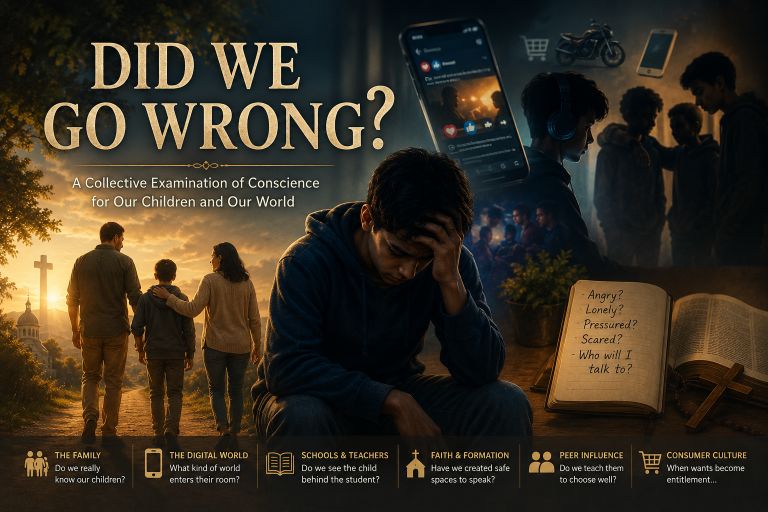
Where Did We Go Wrong?
Dear Fellow Seeker,
I want to talk to you about something that has been disturbing me for the past few days.
I am referring to the murder of the elderly man at Karuvatta, which has shocked Kerala because the alleged perpetrator is a 13-year-old, and the other alleged participants are also minors.
What happened?
According to police investigation reports published between August 18–20, 2026, an elderly man, aged about 65–67, was found dead in his house at Karuvatta. Gold and cash were missing from his house. The police initially suspected robbery, but inconsistencies in the statements led them towards the children themselves.
The police allege that the girl planned the crime and contacted her 17-year-old boyfriend. Two other minors, friends of the boy, allegedly joined them. According to the police, the motive appears to have included obtaining money for an iPhone for the 13 year old minor and a motorcycle for the boys. Police are also examining possible influence from films and other media, previous conflicts with the murdered person, and possible substance use.
What you find in my notes is investigative information from the media these days, not established judicial findings. The children are minors who have been apprehended in connection with the murder, and the investigation is still developing.
But perhaps the more important question for us is:
Where did we go wrong?
This may be a more important question than, "How could these children become involved in such a crime?"
A 13-year-old does not suddenly wake up one morning with a worldview in which human life can be taken for an iPhone or a motorcycle.
The crime may have been allegedly committed by children. But the ecosystem that formed those children belongs, in some measure, to all of us.
This calls for a collective examination of conscience—without excusing the crime or removing responsibility from those involved.
1.The Family
Parents and guardians need to ask:
Do I really know my child?
Not merely: What marks did my child get? Did my child attend school? Did the homework get done?
But:
Who are my child's closest friends?
What does my child watch?
What does my child fear?
What does my child secretly desire?
Is my child lonely, angry, bullied or abused?
What happens on my child's phone?
Does my child have someone with whom he or she can speak honestly?
A child can live in a family and yet live emotionally alone.
2.The Digital World
What kind of world has entered our children's bedrooms through smartphones?
Children are exposed to violence, pornography, revenge narratives, glorification of crime, consumerism, drugs, violent videos and online relationships with people unknown to parents.
The problem is not simply the smartphone. The deeper problem is unaccompanied exposure to an adult digital world while a child is still emotionally developing.
The Kerala Police statistics showing the continuing scale of crimes against children should make us pause and reflect.
3.Schools and Teachers
Have our educational institutions become too focused on:
marks + examinations + academic performance
while giving insufficient attention to:
character + relationships + emotional maturity + empathy + responsibility?
A child may be excellent in mathematics, science and English and still not know:
"What do I do when I am extremely angry?"
"How do I handle peer pressure?"
"How do I respond when someone hurts me?"
"How do I say NO?"
"Whom can I tell when something is wrong?"
These are life skills, not optional extras.
Teachers too need to ask:
Do we notice the child behind the student?
A quiet or introverted child may be lonely, frightened, bullied, traumatised, abused or simply unable to trust adults. Quiet children also need to be seen.
4.Religious Institutions, Cultural Associations and Those Who Form Young People
For those of us committed to the education and formation of young people, there is a deeper question.
We have been good at telling children:
"Don't do this. Don't do that."
But have we taught them sufficiently:
"Why is another human being sacred?"
Have we created safe spaces where young people can speak honestly about anger, sexuality, relationships, loneliness, pornography, abuse, drugs, peer pressure, family conflict, doubts about faith and hatred?
Every child should have at least one trustworthy adult whom he or she can approach without fear of being judged, punished or humiliated.
Education must become not merely moral instruction, but accompaniment.
5.Peer Influence
What happens when children begin raising one another?
The alleged boyfriend and his friends are themselves minors. This reminds us how powerful peer influence can become during adolescence.
We cannot simply tell young people, "Choose good friends."
We must help them learn how to choose friends, resist peer pressure, recognise manipulation and develop moral courage.
6.Consumer Culture
An iPhone and a motorcycle are ordinary consumer objects. But if a child begins to believe:
"I must have this." → "I need money to get it." → "Anything is justified to get it,"
then the problem is deeper than materialism.
What definition of success are we giving our children?
Have we created a culture in which possessing things becomes more important than becoming someone?
7.Media and Entertainment
If films or other media have influenced the thinking of children involved in this case, it should make us reflect—not necessarily about banning films, but about media literacy.
Children need to learn:
A movie is not reality.
Violence has consequences.
Crime is not an adventure.
You cannot simply copy what you see on a screen.
The question is not only what children watch, but whether adults help them process what they watch.
8.Drugs and Substance Use
Reports that police are investigating possible substance use and how minors may have obtained intoxicating substances deserve serious attention.
How are children getting access to drugs?
Who supplies them?
Who knows?
Who looks away?
This is not simply a children's problem. It may also reveal an adult criminal ecosystem exploiting children.
9.Society
Perhaps the biggest question is:
Have we become a society that notices children only when they become a problem?
When a child succeeds, we say, "What a good child!"
When something goes wrong, we ask, "What is wrong with today's children?"
But between these two points lie years of formation.
Where were we during those years?
The responsibility for examining ourselves belongs to:
Parents and family
Friends and peer groups
Schools and teachers
Counsellors, institutions, religions, political parties, child-protection systems,
cultural institutions,
Neighbourhoods and communities,
Media and entertainment industries,
Digital platforms,
Government and law-enforcement agencies,
Political and social leadership,
Society as a whole
And finally:
We ourselves.
It is easy to look at these children and ask:
"What is wrong with them?"
The harder question is:
"What was missing in their world that children could arrive at a place where killing another human being became thinkable?"
That question does not excuse the children.
It asks something more demanding of us:
What must we change so that the next child does not reach the same place?
Perhaps that is the most important lesson we can draw from this tragedy.
The question should not be only:
"Who killed the elderly man?"
It should also be:
"What kind of family, school, institution, community, digital culture, consumer culture and society are we creating in which minors can become involved in something like this?"
That could be a real collective examination of conscience.
Could We Make This a Genuine Conversation?
Could we make this a genuine conversation among ourselves—in our communities, institutions, families, and with the young people and others whom we are in contact with or whom we serve?
The incident is still at the stage of allegations. Nothing has been proved conclusively, and investigations are ongoing.
Yet, whatever we know and hear are sufficient to prompt us to examine ourselves.
A handful of discussion questions could make the piece far more useful than the piece alone, than just reading it, something to actually do with it rather than just nod along.
On formation and presence:
When did we last ask a young person in our care what they secretly fear, rather than how they are doing in their studies?
Is there a young person right now whom we sense is emotionally alone even while surrounded by family or community? What would it take for us to notice that?
In the digital world:
Do we actually know what the young people around us are watching, following, and being shaped by online, or have we quietly decided that it is not our domain?
What would it mean for an educational institution to treat digital accompaniment as seriously as it once treated moral instruction?
On consumer culture and worth:
Where in our own preaching or teaching do we unintentionally reinforce the idea that having the right phone or the right image is what makes a young person acceptable among peers.
Have we offered a compelling alternative story about what makes a life worth living, or only warnings against materialism?
On peer influence:
What spaces do we currently offer where a young person could speak honestly about anger, pressure from friends, or something happening in a relationship, without fear of being corrected before being heard. Are those spaces real or theoretical?
On our own institutional habits:
Have we, as an institution, become better at responding once something goes wrong than at noticing quietly beforehand?
What would earlier noticing actually require of us in terms of time and attention we are not currently giving?
A closing question that ties it together: If your institution sat with this case honestly, what is one concrete change, however small, we would make in how we accompany the young people in front of us this year?
Beyond the questions themselves, a few practical suggestions worth suggesting.
Ask each community or group to name one concrete action rather than let the conversation end in general agreement, since that is where these discussions usually lose their force.
Suggest starting the conversation with silence rather than debate, perhaps a few minutes for each person to write down honestly where they think they personally have been absent or inattentive, before anyone speaks aloud.
That tends to produce more honesty than an open discussion launched cold. And you might consider following up in a few weeks, not to check compliance, but to ask what, if anything, actually changed, since a single conversation that is never revisited tends to fade quickly into the same pattern the piece is trying to interrupt.