

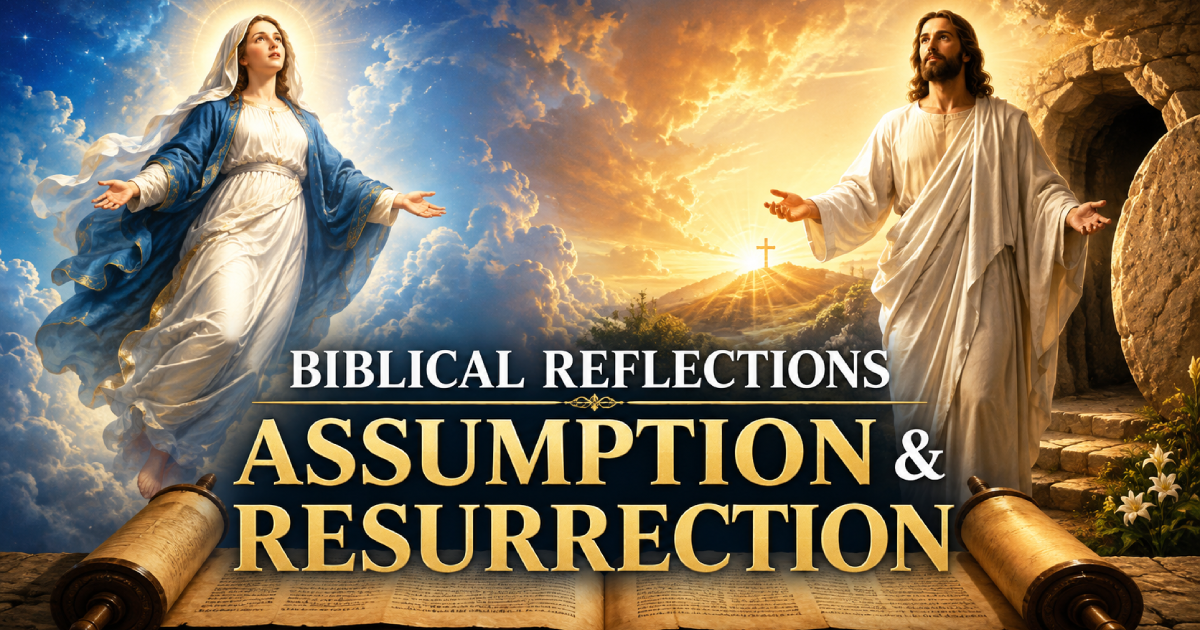
Biblical Reflections on Assumption and Resurrection
The Old Testament and the New Testament contain several teachings related to death and the life hereafter. The classic texts on resurrection [life-hereafter] are found in the book of 2 Maccabees. The biblical author speaks of a mother who motivated her seven sons to die as martyrs rather than abandon their faith (2 Mac 7). She did so because she believed in the resurrection of the dead! The same biblical author speaks of prayers offered on behalf of those who had died in battle. This was done precisely because of the belief in the resurrection of the dead (2 Mac 12:38-45). There is another teaching on the resurrection in the book of the prophet Daniel (see Dan 12:1-3).
We have three individuals in the Old Testament whose earthly sojourns ended in a spectacular manner. The first example is that of Enoch. The author of the book of Genesis puts it thus: “Enoch walked with God; then he was no more, because God took him” (Gen 5:24). This verse has given rise to the view that he was transformed at the end of his life, that is, he was taken up into heaven! The second example is that of Moses – the great leader of the community of Israel. He had led them for 40 years! Surprisingly, no one knows where his tomb is. The narrative goes like this: “He was buried in a valley in the land of Moab … but no one knows his burial place to this day” (Deut 34:6). That is inexplicable! Not to know the burial place of such a prominent person is difficult to explain. Therefore, the story spread that God took him to heaven in some extraordinary manner! The third example is that of the prophet Elijah, who was carried off into heaven in a chariot (2 Kings 2:1-12). That too was unique and was referred to as the ascension of Elijah to heaven!
Jesus talked frequently about a life hereafter. He spoke of death, judgement, and punishment or reward. Here one can think of the parable of the wheat and the weeds (Mt 13:24-20, 36-43), the dragnet that collects fish of various kinds (Mt 13:47-50), the parable of the ten bridesmaids (Mt 25:1-13), the parable of the last judgement (Mt 25:31-46), the parable of Lazarus and the rich man (Lk 16:19-31), etc. The punishment or reward would be in the resurrection of the dead!
Jesus’ most extensive discourse on resurrection is linked to the Eucharistic discourse in the fourth Gospel (Jn 6:25-71). Jesus prepared his listeners for belief in the resurrection through the miracles that he had performed. Besides the multiplication of bread which took place prior to the Eucharistic discourse (Jn 6:1-5), he had resuscitated three persons: the little girl (Mt 9:18-31), the son of the widow (Lk 7:11-17), and Lazarus (Jn 11:1-44). Jesus taught about the life hereafter in a convincing manner and endorsed them with his mastery over death!
Jesus repeatedly spoke about his death and resurrection. The many passion predictions (found in all four Gospels) linked his death to his rising from the dead. All the four Gospels culminate in the resurrection narratives. Luke, in his Gospel and in his history of the Early Church, recounts the ascension of Jesus (Lk 24:50-53; Acts 1:6-11).
In his letter to the community at Corinth, Paul has given an extensive description of the resurrection, which is the foundation of Christian faith (1 Cor 15:1-58). Among other things, Paul speaks of the transformation that takes place at one’s death (see especially 1 Cor 15:50-57). Paul, when standing before Felix, the Roman governor, would state emphatically that he was standing on trial for his belief in the resurrection of the dead (Acts 24:21; 26:8, 23)
Having recalled the above details, we now turn to the dogma of the Church, namely, Mary was assumed into heaven (Pope Pius XII, 1950). Mary, the mother of Jesus, was unique in all creation! She was the beloved of the Father; she was full of Grace – thanks to the intervention of the Holy Spirit; she was spectacular for she gave birth to Jesus. She was greeted by the angel, admired by Elizabeth, proclaimed blessed by the woman in the crowd, honoured by Jesus at Cana, handed over to the care of John who took her home, and surrounded by the early Community in the upper room. Therefore, one may endorse with certainty the belief of the community of believers; they believed that Mary was taken up into heaven without her body undergoing corruption. Her death and entry into heaven coincide simultaneously. God could do it! Therefore, God did it.
The feast of the Assumption is an invitation ‘to seek things that are above and to set our minds on things that are above’ (Col 3:1-2). The solemnity of the Assumption of our Blessed Mother will attain its desired effect when we live by Paul’s directive to the Colossians.