

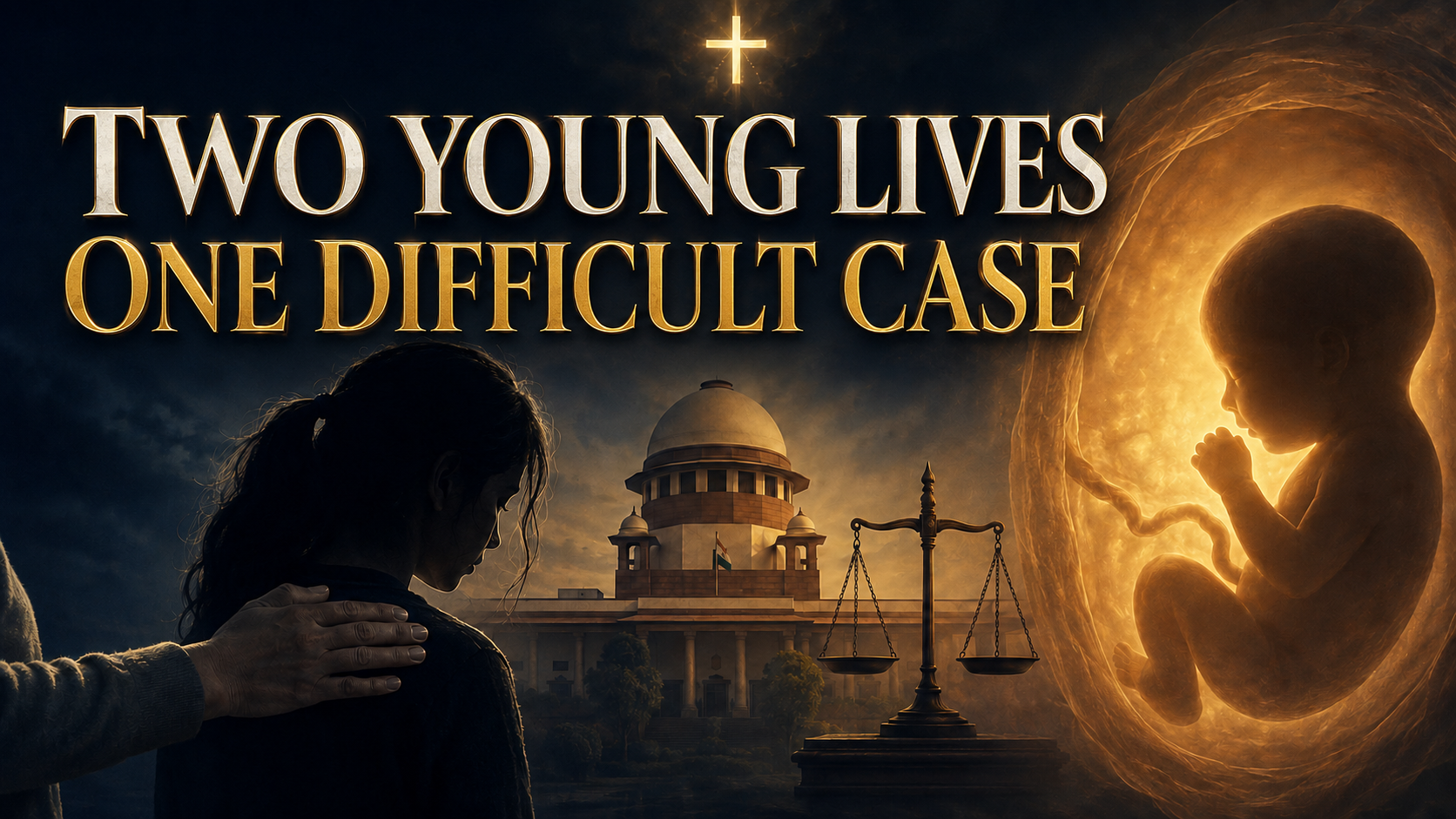
TWO YOUNG LIVES, ONE DIFFICULT CASE
By
Dr. Linto K B.
Advocate-on-Record, Supreme Court of India
Fr. (Dr.) Jose Thomas SDB.
Vice-Principal, Don Bosco College (Autonomous), Maram
A Catholic Response to the Supreme Court of India’s Order on a Minor’s Late-Term Pregnancy
In brief: A painful Supreme Court case involving a 15-year-old girl and an advanced pregnancy raises difficult questions about reproductive autonomy, medical judgement and the dignity of unborn life. A Catholic response must defend both mother and child, while offering practical care rather than condemnation.
Few moral questions are more painful than those in which two vulnerable human lives seem to stand on opposite sides. The recent case before the Supreme Court of India involving a very young pregnant girl is one such case. It deserves neither slogans nor anger. It calls for compassion, careful thought and a serious defence of human dignity.
The girl was only fifteen. The Supreme Court recorded that her pregnancy arose from a consensual relationship with a 17-year-old boy, who was himself a minor. Under India’s Protection of Children from Sexual Offences Act (POCSO), a person below eighteen is legally a child, so sexual activity involving a child falls within the child-protection framework even where the young persons describe the relationship as consensual. [1]
The official Supreme Court order of 24 April 2026 described the pregnancy as twenty-eight weeks. By the time of later proceedings, public reports described it as approximately thirty weeks. The main judgment was delivered by Justices B. V. Nagarathna and Ujjal Bhuyan. AIIMS later sought review, which the same bench dismissed on 29 April. A further challenge was reported on 30 April before Chief Justice Surya Kant and Justice Joymalya Bagchi. Finally, on 4 May, the Supreme Court was informed that the termination had been carried out. [1, 2, 3, 4]
These details matter. But behind every legal document are human beings: a frightened teenage girl, her anguished family and an unborn child already far advanced in development.
From a Catholic point of view, we must refuse to forget either of them.
A Child Facing Motherhood
The circumstances of the girl deserve profound compassion.
According to the Supreme Court judgment, the pregnancy was discovered very late. The girl was experiencing severe emotional distress, and her lawyers told the Court that she had attempted suicide twice. They argued that forcing her to continue the pregnancy would violate her bodily integrity, reproductive autonomy and right to life under Article 21 of the Constitution. [1]
No Christian response should minimise this suffering.
A fifteen-year-old facing pregnancy needs protection, psychological care, education, a safe home, medical attention, family support and freedom from shame. She should never be treated as morally disposable because she became pregnant outside marriage. Christians should be among the first to reject the cruel social stigma that can make a frightened girl feel that her life is over.
She is a child who needs to be loved and protected.
But she is not the only young life involved.
There is also the unborn child.
And Catholic ethics insists that compassion for one cannot require the intentional destruction of the other.
What the Doctors were Concerned About
The medical questions were unusual because this was not an early pregnancy.
The Delhi High Court had considered the report of an AIIMS Medical Board. According to the Supreme Court’s own account, doctors said that if delivery occurred at that stage, the baby would probably be born alive and require active resuscitation. The High Court also recorded concern that termination could pose significant risks to the girl’s future reproductive health. The Union and State governments urged continuation of the pregnancy and offered State-supported care and adoption if the girl did not wish to raise the child. [1]
The Supreme Court nevertheless placed very great weight on the girl’s mental suffering, future, bodily integrity and reproductive choice. It held that constitutional courts could grant relief even where the pregnancy had crossed the ordinary statutory time limits. It ordered AIIMS to perform the termination with appropriate medical safeguards. [1]
AIIMS then filed a review petition. On 29 April, the Court dismissed it. Later proceedings were reported as stressing that medical professionals could advise about risks but should not become the final decision-makers in place of the girl and her family. The Chief Justice-led bench was also reported to have urged the Government to reconsider statutory gestational limits in cases involving minors and pregnancies arising from sexual offences. [2, 3]
The Court’s concern for the girl is understandable.
The Catholic objection concerns the means chosen.
Catholic Teaching Begins with the Dignity of Both
Catholic teaching on abortion is not based first on punishment, politics or condemnation. It begins with a simple conviction: human life is a gift, and innocent human life possesses a dignity that others may not deliberately take away.
The Catechism teaches that human life must be respected and protected from conception, and that direct abortion, abortion deliberately chosen either as an end or as a means, is gravely contrary to the moral law. This teaching has been part of Christian moral tradition from its earliest centuries. (Catechism of the Catholic Church, 2270–2271) [5]
“Human life must be respected and protected absolutely from the moment of conception.”
CCC, 2270
This conviction is also biblical. The Psalmist speaks to God:
“You formed my inmost being; you knit me in my mother’s womb.” Psalm 139:13
The Bible does not give us a modern medical textbook. But it consistently speaks of human life as received from God rather than manufactured or owned by us.
St John Paul II expressed the same principle powerfully in Evangelium Vitae. He taught that innocent human life may never be deliberately killed and called upon society to “respect, protect, love and serve life, every human life!” [6]
That “every” is important.
It includes the unborn child.
It also includes the frightened fifteen-year-old mother.
One Injustice Cannot be Cured by Another
Cases involving pregnancy after sexual abuse or unlawful sexual activity are emotionally difficult precisely because the mother may be completely innocent of the circumstances that have wounded her.
Catholic moral teaching never says that such suffering is insignificant. Sexual exploitation of a child is a serious injustice. Those responsible must be dealt with according to law, while remembering that in this particular case the Supreme Court recorded that the boy was also a 17-year-old minor. The legal process therefore has to respect both POCSO and the protections applicable to children in conflict with the law. [1]
But the unborn child did not cause the situation.
The child in the womb cannot be assigned the guilt of another person.
This is why Catholic ethics cannot accept the argument that abortion becomes morally good because the circumstances of conception were tragic. The suffering can change what support is urgently needed. It cannot change the basic innocence of the unborn child.
Sometimes this case has been described as a conflict between a pregnant child and a foetus. Catholic moral reasoning refuses to accept that we must simply choose which one matters.
There are two young human lives before us. Our moral imagination should be large enough to seek the good of both.
Thirty Weeks is not an Early Stage of Pregnancy
Medical viability does not create human dignity. From the Catholic perspective, the unborn child is worthy of protection from conception, not only after reaching an age at which survival outside the womb becomes possible.
Nevertheless, viability makes this particular case especially serious.
Modern obstetrics normally describes the “periviable period” (the border of possible survival) as roughly 20 weeks through 25 weeks and 6 days. Thirty weeks is therefore well beyond the usual periviable period. [7]
Outcomes naturally vary according to birth weight, medical complications, the quality of neonatal care and other factors. But survival at this stage is generally high in well-equipped neonatal centres. A large French population study reported 93.6% survival to discharge among live-born infants at 27-31 weeks and 98.9% at 32–34 weeks. [8]
That does not mean premature delivery at thirty weeks is harmless. Such babies can face breathing difficulties, neurological complications, feeding problems and prolonged neonatal intensive care. Every additional week of healthy development in the womb can make an important difference.
This explains why the concerns of specialised doctors deserved serious consideration.
At such an advanced stage, “termination of pregnancy” is no longer an abstract phrase. The Court record itself recognised the possibility that the baby would be delivered alive and need resuscitation. [1]
That moral reality should not disappear behind medical or legal terminology.
A Word of Caution About Claims of Foetal Pain
Pro-life discussions sometimes claim that science has definitively established conscious foetal pain from around 20 weeks. The scientific position is more complicated than that.
Professional bodies such as the American College of Obstetricians and Gynaecologists cite evidence against conscious pain perception before 24 weeks, while some researchers have argued that the question should be reconsidered. [9]
Catholic teaching does not depend on settling this scientific debate.
A human being does not acquire a right to life when he or she becomes capable of feeling pain. A sleeping adult, a person under anaesthesia and a patient with severe neurological impairment do not lose human dignity because their awareness of pain is reduced or absent.
The Catholic defence of unborn life is based on what the unborn child is, not simply on what the child can presently feel.
What Indian Law Normally Provides
For readers outside India, it may help to explain the law simply.
Under the Medical Termination of Pregnancy Act, termination is ordinarily permitted up to 20 weeks under specified medical conditions on the opinion of one registered medical practitioner. For prescribed categories of women, including minors and certain pregnancies resulting from rape, the law extends the framework beyond 20 weeks and up to 24 weeks, subject to additional medical requirements. [10]
Beyond those ordinary limits, the Act makes special provision for substantial foetal abnormalities diagnosed by a Medical Board. Section 5 separately removes certain limits when termination is immediately necessary to save the pregnant woman’s life. [10]
The present case therefore went beyond the ordinary statutory pathway.
It would not be accurate simply to say that the Supreme Court “ignored the law”. The Court consciously held that constitutional courts possess power to provide a remedy beyond the statutory framework when fundamental rights require it. That is precisely why the case is important. [1]
The Catholic concern is that such constitutional reasoning may gradually make the statutory gestational safeguards less meaningful, particularly when the unborn child is already viable, and specialist doctors have raised serious medical objections.
The Court Itself has Not Always Taken the Same Approach
Indian abortion jurisprudence has developed over time.
In Suchita Srivastava v. Chandigarh Administration (2009), the Supreme Court defended the reproductive choice of a woman with an intellectual disability and refused to permit termination against her wishes. The case strongly connected reproductive choice with bodily integrity and personal liberty. [11]
In X v. Union of India (2023), however, the Supreme Court ultimately refused permission for termination of a pregnancy at approximately 26 weeks where viability and the statutory conditions became central concerns. [12]
Then, in February 2026, shortly before the present case, another Supreme Court judgment allowed termination of a pregnancy at about 30 weeks in circumstances involving a young woman who had conceived while still a minor. The April judgment expressly relied upon that more recent approach. [13]
So, the April 2026 decision did not appear out of nowhere. It forms part of a developing line of cases in which the Court has increasingly emphasised reproductive autonomy even at very advanced gestations.
That development deserves careful public debate.
Autonomy Matters But Is Autonomy Absolute?
Personal autonomy is an important human good. Catholic teaching strongly defends freedom and rejects coercion.
But no human freedom is completely unlimited.
My freedom does not allow me intentionally to kill another innocent person. My bodily autonomy does not give me authority over every other human life affected by my decisions. Society constantly balances autonomy with duties towards children, patients, neighbours and vulnerable people.
The central disagreement, therefore, is not over whether the girl has dignity and freedom. She certainly does.
The disagreement is over whether the viable unborn child also possesses a moral claim that places limits on what may intentionally be done.
Catholic teaching answers yes.
The Court gave priority to the pregnant minor’s choice. Catholic moral teaching asks society to search for an answer in which her freedom, future and healing are protected without intentionally ending the life of her child.
Doctors, Patients and Moral Responsibility
The later hearings reportedly included the view that doctors must not become the “masters” of a patient’s will. There is an important truth here: medicine should not become paternalistic, and patients are not objects to be managed. [3]
But autonomy is only one principle of medical ethics.
Doctors also have responsibilities of beneficence, non-maleficence, professional judgement and care for vulnerable human life. In an advanced pregnancy where delivery may produce a living premature infant, the medical team is no longer dealing with a simple one-person situation.
The case therefore raises an important question for the future: what should happen when a court, a family and highly specialised doctors disagree over a procedure involving two patients and potentially irreversible consequences?
That question deserves more careful discussion than either “doctors know best” or “choice decides everything”.
Direct Abortion and Treatment to Save the Mother are Not the Same Thing
Catholic teaching also makes an important distinction that is sometimes misunderstood.
If a pregnant woman develops a life-threatening medical condition, doctors may give genuinely necessary treatment to save her life even when the unintended result is the death of her unborn child. The death must not be the means chosen to achieve the good result. [14]
That is morally different from directly intending the death of the unborn child.
Catholic ethics therefore does not say, “Let the mother die rather than intervene.” It says that both patients must be treated as persons, and that medicine should never intentionally kill one as the means of helping the other.
The Answer Must Be More Than “Do Not Abort”
This is where Christians must examine themselves.
It is not enough to tell a fifteen-year-old, “You must continue the pregnancy,” and then disappear.
A genuine culture of life accepts responsibility.
A pregnant minor may need months or years of assistance: trauma counselling, protection from abuse, safe accommodation, good medical care, the possibility of continuing her education, financial assistance, help for her family, confidential pastoral support and freedom from social humiliation.
If she cannot or does not wish to raise the baby, ethical and carefully regulated adoption may provide another path.
Catholic dioceses, religious congregations, hospitals and charities already have many forms of healthcare and social ministry in India. The challenge is to strengthen these networks so that a frightened girl can see a future for herself and her child.
The Christian alternative to abortion must never be abandonment.
What Should Be Done Now?
- India should retain serious safeguards for very late abortions while greatly expanding care for pregnant minors and victims of sexual abuse. This means immediate counselling, mental-health treatment, continued schooling, safe housing, financial assistance, excellent obstetric and neonatal care, and swift legal protection. Adoption services should be transparent, humane and easily accessible where desired.
- Cases beyond the normal statutory gestational limits should receive the highest level of medical and ethical scrutiny. Foetal development and viability, risks to the mother, mental-health evidence and genuine medical emergencies should all be examined carefully. Constitutional compassion should not make the life of a viable unborn child morally invisible.
- Christian institutions should strengthen practical pro-life ministries. Crisis-pregnancy care, support for young mothers, adoption assistance, responsible family-life and sex education including chastity (abstinence), trauma counselling and compassionate post-abortion healing should become more visible and accessible. Government, other religions and civil society should be welcomed as partners wherever cooperation can protect vulnerable women and children.
- Christians must speak for life without speaking cruelly. Catechesis, schools, media and interfaith dialogue should defend unborn human dignity while rejecting shame, aggression and condemnation of women in crisis pregnancies. A pro-life message is credible only when people can see pro-life love in action.
We Should Also Listen to What This Case Reveals About Society
Why should a fifteen-year-old believe that motherhood would destroy her future?
Part of the answer may be the genuine difficulty of adolescent pregnancy. But another part may be the way society treats an unmarried pregnant girl.
If stigma becomes one of the reasons for ending a child’s life, then Christians should not merely criticise abortion. We should also fight the stigma.
A girl who becomes pregnant must not lose her education, her family, her dignity or her place in society.
Her child must not be called a disgrace.
Compassion means making room for both.
Law Can Permit Something That Morality Still Questions
India is a constitutional democracy and a religiously plural society. The Catholic Church does not expect civil law simply to reproduce Catholic canon law or theology.
But Christians have the same democratic responsibility as other citizens to bring moral arguments into public discussion.
A Supreme Court decision settles a particular legal matter. It does not prevent citizens, doctors, theologians, lawyers and legislators from asking whether the law adequately protects every human being affected.
Nor should disagreement with a judgment become disrespect for the judiciary.
One can respect the Court, understand its concern for a deeply distressed minor and still believe that its moral reasoning did not give sufficient weight to the unborn child.
That is the position this Catholic reflection takes.
Two Lives, Not Competing Objects
This case should not finally be remembered as a battle between “a foetus and a child”.
It concerned a child and her unborn child.
The first deserved protection from trauma, fear, social shame and a future closed by circumstances beyond her maturity.
The second deserved protection precisely because he or she had no voice, no lawyer of his or her own and no ability to ask for mercy.
The answer to vulnerability should be greater care, not a decision about which vulnerable life may be sacrificed.
The Catholic Church’s teaching remains demanding because it insists upon something society sometimes finds very difficult: the dignity of one human being does not cancel the dignity of another.
St John Paul II’s invitation in Evangelium Vitae remains timely:
“Respect, protect, love and serve life, every human life!” Evangelium Vitae, no. 5
That must include the frightened mother.
It must include the unborn child.
It must include families who feel trapped and doctors carrying difficult responsibilities.
And it must call Christians beyond words to homes, hospitals, schools, counselling rooms, adoption services, legal aid and communities where a young mother can hear something much more hopeful than, “There is no way out.”
She should be able to hear:
“You are not alone. Your life matters. Your child’s life matters. We will help you protect both.”
References and Sources
- Supreme Court of India. S, Mother of N v. Union of India & Ors., Civil Appeal No. 6667 of 2026, final order dated 24 April 2026. Source (https://api.sci.gov.in/supremecourt/2026/24448/24448_2026_4_65_70489_FinalOrder_24-Apr-2026.pdf)
- Supreme Court of India. All India Institute of Medical Sciences, New Delhi v. S, Mother of N & Ors., Review Petition order dated 29 April 2026. Source (https://api.sci.gov.in/supremecourt/2026/25648/25648_2026_4_1004_70739_Order_29-Apr-2026.pdf)
- The Indian Express. “SC rejects AIIMS plea on 30-week abortion, backs minor’s choice,” 30 April 2026. Source (https://indianexpress.com/article/legal-news/supreme-court-aiims-30-week-abortion-minor-case-10663833/)
- The Indian Express. Report on Supreme Court dropping contempt proceedings after AIIMS confirmed compliance in the minor’s pregnancy-termination case, published 5 May 2026. Source (https://indianexpress.com/article/legal-news/supreme-court-drops-aiims-contempt-30-week-minor-pregnancy-mtp-act-ruling-10673813/)
- Catechism of the Catholic Church. Nos. 2270–2271, on respect for human life and procured abortion. Source (https://www.vatican.va/content/catechism/en/part_three/section_two/chapter_two/article_5/i_respect_for_human_life.html)
- John Paul II. Evangelium Vitae, 25 March 1995, especially nos. 5, 57–62. Source (https://www.vatican.va/content/john-paul-ii/en/encyclicals/documents/hf_jp-ii_enc_25031995_evangelium-vitae.html)
- American College of Obstetricians and Gynecologists. Periviable Birth, Obstetric Care Consensus No. 6. Source (https://www.acog.org/clinical/clinical-guidance/obstetric-care-consensus/articles/2017/10/periviable-birth)
- Ancel, P.-Y., Goffinet, F., and the EPIPAGE-2 Writing Group. “Survival and Morbidity of Preterm Children Born at 22 Through 34 Weeks’ Gestation in France in 2011: Results of the EPIPAGE-2 Cohort Study.” JAMA Pediatrics 169, no. 3 (2015): 230–238. doi:10.1001/jamapediatrics.2014.3351. Source (https://jamanetwork.com/journals/jamapediatrics/fullarticle/2091623#google_vignette)
- American College of Obstetricians and Gynecologists. Gestational Development and Capacity for Pain. Source (https://www.acog.org/advocacy/facts-are-important/gestational-development-capacity-for-pain)
- Government of India, India Code. The Medical Termination of Pregnancy Act, 1971, as amended, including the 2021 amendments. Source (https://www.indiacode.nic.in/handle/123456789/19991?locale=en)
- Supreme Court of India. Suchita Srivastava & Anr. v. Chandigarh Administration, Civil Appeal No. 5845 of 2009, decided 28 August 2009; (2009) 9 SCC 1. Source (https://api.sci.gov.in/jonew/judis/35395.pdf)
- Supreme Court of India. X v. Union of India, 2023 INSC 919, judgment dated 16 October 2023. Source (https://api.sci.gov.in/supremecourt/2023/42181/42181_2023_1_24_47700_Judgement_16-Oct-2023.pdf_
- Supreme Court of India. Judgment dated 6 February 2026 concerning termination of a pregnancy at approximately 30 weeks in a case involving conception while the petitioner was a minor. Source (https://api.sci.gov.in/supremecourt/2026/5844/5844_2026_3_62_67905_FinalOrder_06-Feb-2026.pdf)
- Congregation for the Doctrine of the Faith. Clarification on Procured Abortion, 11 July 2009; distinction between direct abortion and necessary treatment whose unintended side effect may be the death of the unborn child. Source (https://www.vatican.va/roman_curia/congregations/cfaith/documents/rc_con_cfaith_doc_20090711_aborto-procurato_en.html)