

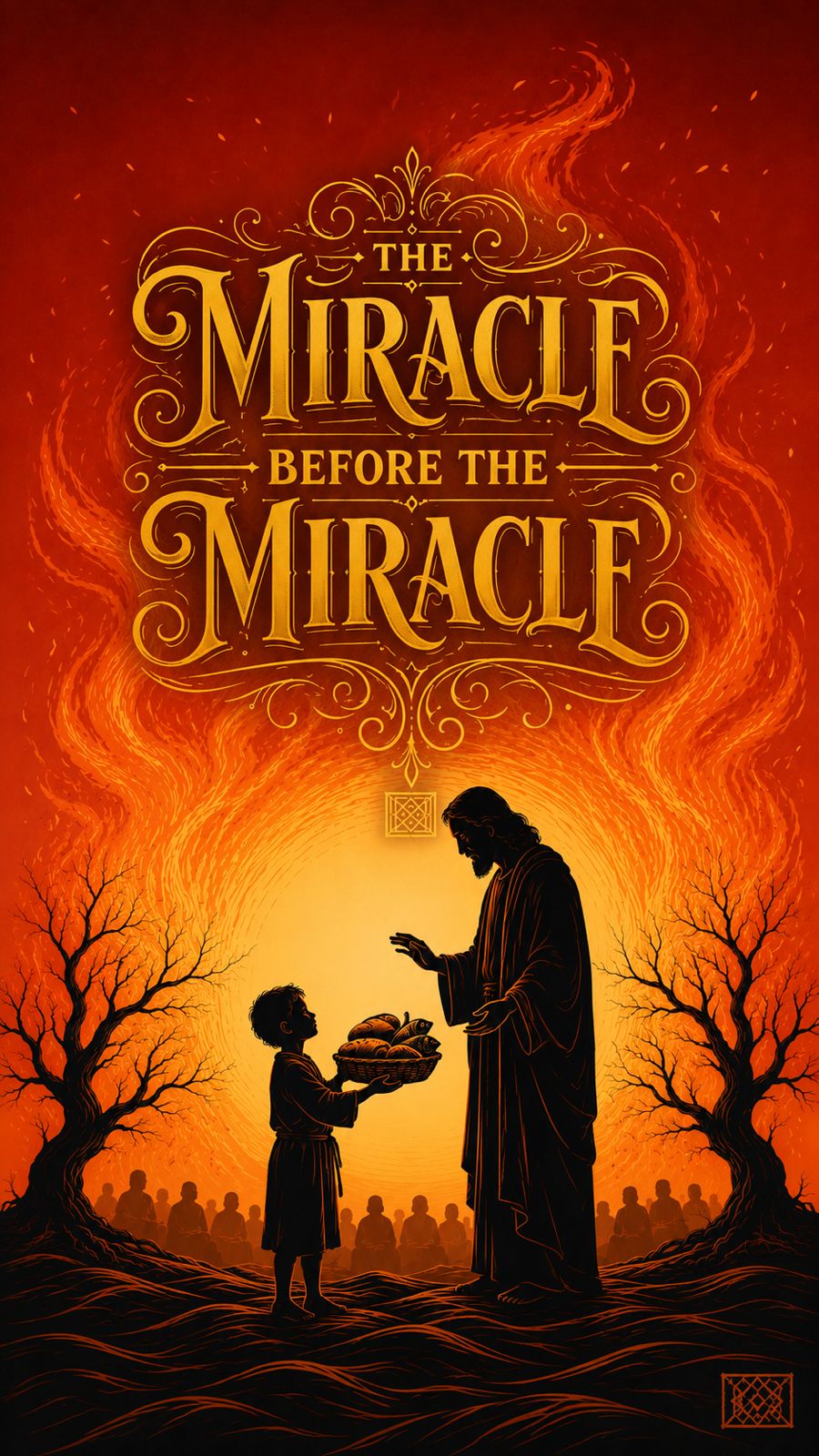
The Miracle Before the Miracle
Every time I read the story of the multiplication of the loaves, my eyes wander to someone most people overlook. A little boy, standing quietly in the crowd. Without his generosity, there is no bread for Jesus to bless.
But then my imagination goes even further, to someone who never appears in the story at all: his mother.
Maybe that morning she packed five loaves and two fish into her son's small bag. She let him spend the day listening to Jesus, a man admired by many but also questioned, criticized, and mistrusted by the religious authorities.
The little boy stands quietly in the crowd. His mother remains quietly in the background.
One is seen. The other is unseen.
And that makes me wonder: Who was this woman?
What kind of mother raises a child who instinctively shares the little he has? The Gospel is silent.
So let me imagine for a moment.
Perhaps she was another anonymous person we meet in the Gospels—the poor widow who quietly walked into the Temple treasury and dropped in two small coins.
Jesus noticed her because, although she had almost nothing, she gave everything.
Now imagine this.
A few weeks later, perhaps her little boy stood on another hillside, listening to Jesus. This time he carried five loaves and two fish.
Once again, someone with almost nothing gave everything.
Did it happen that way? We do not know whether the widow was his mother.
But we know this: Every generous child has almost certainly been formed by someone else's generosity.
Perhaps the widow never realised that the greatest gift she offered God was not the two coins she placed in the Temple treasury, but the generous heart she quietly formed in her son.
One of the greatest gifts parents give the world is not successful children, but children whose hearts have been well formed.
The miracle did not create that generosity. It revealed it.
Perhaps that is where today's miracle really begins.
Not on the hillside. But in a home. In a kitchen.
A mother prepares lunch before her son leaves for the day. She teaches him, not with lectures, but by the way she lives:
"If someone is hungry, you share."
Children rarely become generous by accident.
They watch. They imitate. They absorb.
Around the family table they learn whether life is about holding on or about sharing.
Families do not just pass on property. They also pass on traditions, habits, and a way of seeing the world.
And that is why Jesus asks such an important question.
"What do you have?"
That question echoes throughout the Bible.
To Moses: "What is in your hand?" A shepherd's staff.
To the widow of Zarephath: "What do you have in your house?" A little oil.
To the disciples: Five loaves. Two fish.
God rarely starts with what people lack. He starts with what they are willing to give Him. The Kingdom grows not from abundance, but from willingness.
I often wonder why that little boy was following Jesus. Jesus was no ordinary teacher. He challenged religious leaders. He welcomed tax collectors. He touched lepers. He associated with people respectable society avoided. Many adults distrusted Him.
Yet here was a little boy spending the whole day listening to Him.
What kind of family raises a child like that?
Could it have been a family where truth mattered more than reputation, compassion mattered more than public opinion. Parents there taught their children not to fear goodness, even if it was unpopular.
Good values produce courageous children.
We have seen this in our own time.
The world knows the name Malala Yousafzai because of her extraordinary courage. But courage did not begin on the day she was attacked. It began years earlier at home.
Malala’s father, Ziauddin Yousafzai, was a humble schoolteacher. In a society where many believed daughters should remain silent, he chose to treat his daughter differently. He listened to her, encouraged her, and believed in her. Day by day, he planted confidence where society planted fear.
Years later, when violence tried to silence her, Malala found the courage to speak.
The attack did not create her courage. It revealed it.
Perhaps that was also true of the little boy in today's Gospel. The crowd saw five loaves and two fish. Jesus saw something much deeper. He saw a heart that had already been formed.
The miracle on the hillside did not start with bread. It started at home. Then something beautiful happened: one little boy came forward.
The disciples organized the crowd, and people sat down. Soon, hands were passing bread from one person to another, and thousands were eating. One generous act changed how the whole crowd behaved.
That is how the Kingdom of God grows by one generous person inspiring another.
We witnessed something similar during the Kerala floods of 2018.
People often say that Kerala came together. It did. But that unity did not suddenly appear because of the flood. The flood revealed values that had been quietly growing for years in homes, schools and communities.
A college student looked at the chaos and asked a very Gospel question:
"What do I have?"
He did not have a rescue boat. He did not have government authority. He had one gift. He knew how to write computer code. So he created KeralaRescue.in.
Within days, hundreds of software developers joined him, and thousands of volunteers registered. Tens of thousands of rescue requests were coordinated. It was far more than a website. It became the digital nerve centre of the rescue effort. One person's willingness made it possible for thousands of others to help.
At the same time, Johann Binny Kuruvilla volunteered to answer hundreds of distress calls every day. No one appointed him. He stepped forward.
And on the flooded rivers, fishermen like K. P. Jaisal risked everything to rescue strangers.
One unforgettable photograph showed him bending down, offering his back as a human step so frightened women and children could climb safely into a rescue boat.
The flood did not create that generosity. It revealed it.
Those young developers, those volunteers and those fishermen did not suddenly become compassionate that week. Those values had been quietly formed over many years. The crisis revealed the people they had already become.
Exactly like the little boy. He did not become generous when Jesus asked for his lunch. He already was.
Could this be the hidden miracle in today's Gospel? Before Jesus multiplied the bread, someone had already multiplied generosity. A mother had passed on generosity to her son.
That is how God usually changes the world.
A value becomes a habit, and a habit shapes character. Character inspires others. When enough people start living those values, character becomes culture.
Every culture begins in a family.
One day life will test every one of us. Perhaps not with a miracle of bread. But with something just as important.
A neighbour will need help.
A stranger will need kindness.
A family member will need forgiveness.
When that day comes, the crisis will not create our character. It will reveal it.
The question is not whether we will face such moments.
The question is: what will those moments reveal about us?
And the answer to that question is being written today.
In our homes.
Around our dining tables.
In the ordinary conversations we have with our children.
In the values we celebrate.
In the habits we practise.
The world remembers the little boy with five loaves and two fish.
We know nothing about his parents.
Yet maybe the greatest miracle they performed was not raising a child who carried bread, but raising a child who knew how to let it go.
May our homes become places where generous hearts are formed because miracles do not begin with abundance. They begin with values.
And values, more often than not, begin at home.