

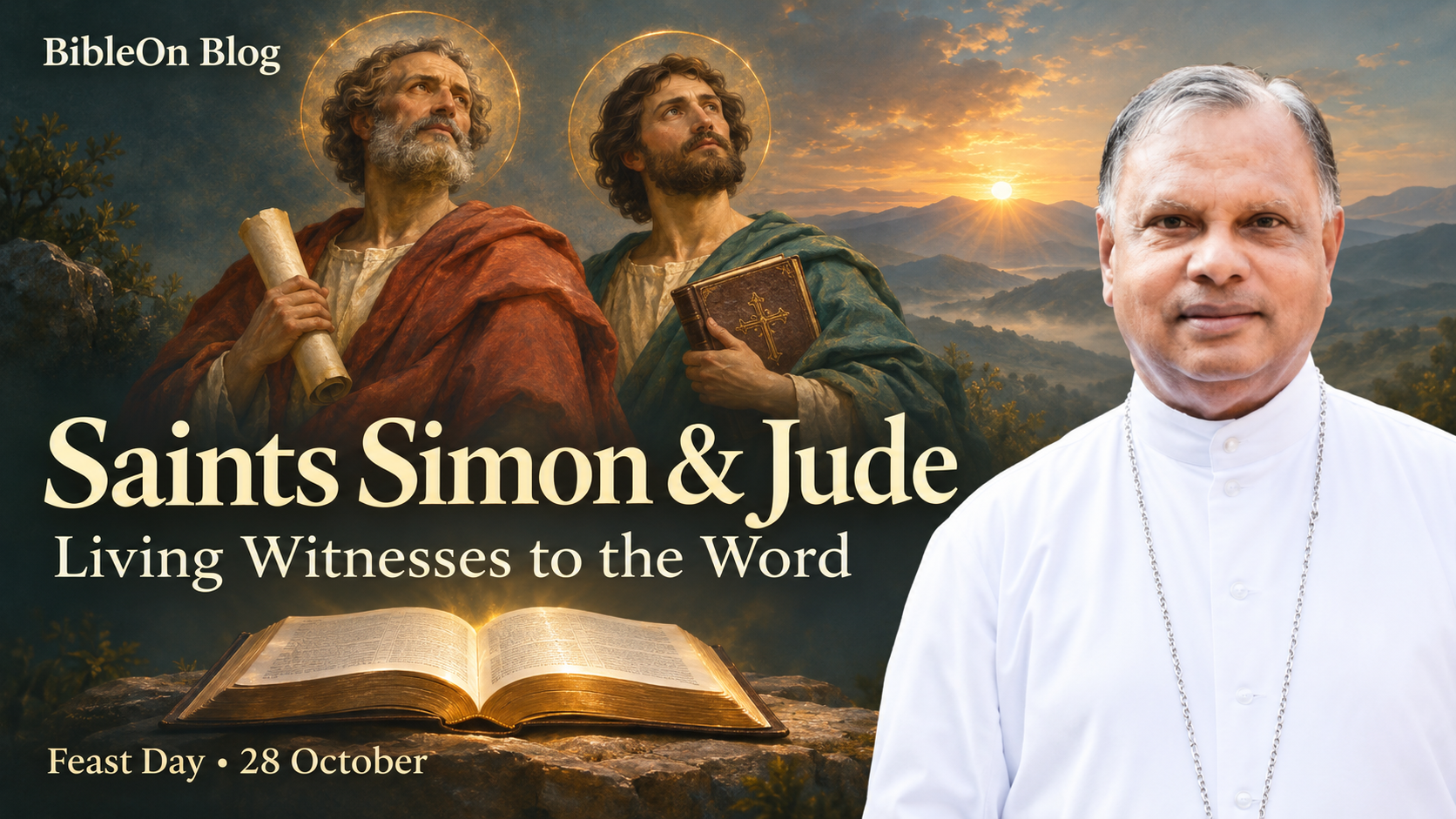
Homily for the Feast of Saints Simon and Jude, Apostles
28 October 2026
(Ephesians 2:19–22; Psalm 19:2–5; Luke 6:12–16)
Dear Reverend Fathers, dear brothers in Christ,
Today, as we celebrate the feast of Saints Simon and Jude, it is a special blessing that we, priests engaged in the biblical apostolate in Northeast India, gather around the altar of the Lord. We celebrate not merely the memory of two Apostles who lived two thousand years ago, but also our own vocation to proclaim and witness to the Word of God.
The Gospels tell us very little about Simon and Jude. Simon is called the Zealot, while Jude is identified as the son of James (Lk 6:15–16). They were not as prominent as Peter, James or John. Yet Jesus chose them to become foundations of his Church.
Their lives remind us of an important truth: The effectiveness of our biblical apostolate depends not primarily on our knowledge, qualifications or achievements, but on our personal relationship with Jesus Christ, the living Word of God.
Today, the Scripture readings invite us to reflect on four dimensions of our biblical mission.
1. Before Proclaiming the Word, We Must Listen to the Word
In today's Gospel, Luke tells us:
“He went out to the mountain to pray; and he spent the night in prayer to God” (Lk 6:12).
Only after spending the night in prayer did Jesus choose his twelve Apostles.
What a profound lesson for us priests!
Jesus did not choose the Apostles after examining their academic qualifications or administrative abilities. Their vocation emerged from his intimate communion with the Father.
Dear Fathers, we organize Bible conventions, seminars, Scripture courses, retreats and pastoral programmes. We prepare homilies, teach Scripture and train biblical animators. All these activities are necessary.
But there is a danger: We may become so busy speaking about the Word of God that we forget to listen personally to the God who speaks through his Word.
The prophet Jeremiah expresses his experience beautifully:
“When your words came, I ate them; they were my joy and my heart's delight” (Jer 15:16).
Before becoming teachers of Scripture, we must remain its disciples. Before explaining the Bible to others, we must allow it to challenge and transform our own lives.
A priest who studies Scripture merely to prepare a homily may become a good preacher. But a priest who meditates on Scripture to encounter Christ becomes a convincing witness.
Our biblical apostolate must therefore begin with biblical spirituality, nourished by prayer, meditation and Lectio Divina.
2. Built upon the Apostles: Christ Is Our Cornerstone
In the first reading, St. Paul reminds us:
“You are ... members of the household of God, built upon the foundation of the apostles and prophets, with Christ Jesus himself as the cornerstone” (Eph 2:19–20).
Simon and Jude belonged to this apostolic foundation. Their mission was not to proclaim their personal ideas but to bear witness to Jesus Christ.
This has special significance for our biblical apostolate in Northeast India.
We work among people belonging to different tribes, languages, cultures and Christian traditions. Such diversity is a great richness, but it also presents pastoral challenges.
Our biblical ministry must remain firmly rooted in Christ and in communion with the Church.
The Second Vatican Council teaches:
“The Church has always venerated the divine Scriptures just as she venerates the body of the Lord” (Dei Verbum, 21).
Our mission is not merely to communicate biblical information but to lead people into a living encounter with Christ.
We must help the faithful discover the connection between Scripture, the Eucharist and Christian life.
The purpose of biblical formation is not simply to produce people who know the Bible, but disciples whose lives are transformed by the Bible.
3. From Proclamation to Witness: Our Lives Must Become the Gospel
Today's responsorial psalm declares:
“Their voice goes out through all the earth, and their words to the end of the world” (Ps 19:4).
The Church applies these words to the apostolic mission of proclaiming the Gospel throughout the world.
In the Acts of the Apostles, Peter and John boldly declare:
“We cannot keep from speaking about what we have seen and heard” (Acts 4:20).
Notice these words: what we have seen and heard.
The Apostles proclaimed not merely what they had learned but what they had personally experienced.
Here lies the difference between a biblical teacher and a biblical witness.
A teacher communicates knowledge; a witness communicates a life transformed by the Word.
Pope St. Paul VI famously observed:
“Modern man listens more willingly to witnesses than to teachers, and if he does listen to teachers, it is because they are witnesses” (Evangelii Nuntiandi, 41).
Dear Fathers, people may forget our biblical lectures, our explanations of Greek and Hebrew words, and even our beautiful homilies.
But they will remember a priest who visited their sick family members, listened patiently to their difficulties, comforted them in sorrow and stood beside them in times of suffering.
Our life must become the most convincing commentary on the Bible we preach.
If we preach forgiveness, we must forgive. If we proclaim love, we must love. If we teach simplicity, we must live simply.
The Word becomes credible when it takes flesh in our daily lives.
4. Biblical Apostolate in Northeast India: Crossing Boundaries
Dear Fathers, our gathering in Northeast India gives today's feast a particular missionary significance.
This region is blessed with rich cultural traditions, numerous indigenous languages and strong community relationships. Many people possess a deep reverence for the Bible.
Yet we also encounter challenges: remote villages, difficult terrain, linguistic barriers, limited biblical resources and the changing attitudes of younger generations.
The missionary spirit of Saints Simon and Jude challenges us to carry the Word beyond our churches and classrooms.
Jesus commands:
“Go therefore and make disciples of all nations” (Mt 28:19).
Our biblical apostolate must reach families, villages, schools, youth groups and Small Christian Communities.
We need well-trained lay biblical animators who can explain Scripture in local languages. We need to encourage family Bible reading and help young people discover the Word through digital media.
Above all, Scripture must illuminate the real struggles of our people: poverty, unemployment, addiction, broken families, violence and the search for peace.
The prophet Isaiah reminds us:
“My word ... shall not return to me empty, but it shall accomplish that which I purpose” (Is 55:11).
Sometimes our programmes may attract only a few participants. Our efforts may not always produce immediate results.
But Saints Simon and Jude remind us that the greatness of apostolic ministry lies not in public recognition or visible success, but in fidelity to Christ and his mission.
Conclusion: Let the Word Dwell in Us
Dear Reverend Fathers,
On this feast of Saints Simon and Jude, let us renew our commitment to the biblical apostolate with four convictions:
•Before proclaiming the Word, let us listen to the Word.
•Before teaching the Word, let us live the Word.
•Before organizing programmes, let us build communities rooted in the Word.
•Before expecting results, let us remain faithful to the Word.
St. Paul exhorts us:
“Let the word of Christ dwell in you richly” (Col 3:16).
May the Word of Christ dwell in our minds through study, in our hearts through prayer, on our lips through proclamation and in our lives through loving service.
As we celebrate this Eucharist, may the Lord renew in us the apostolic zeal of Saints Simon and Jude, so that we may become not merely preachers of the Word, but living witnesses to the Word.
May the people of Northeast India, through our ministry and example, encounter Jesus Christ, the Word made flesh, who alone has the words of eternal life (Jn 6:68).
Amen.