

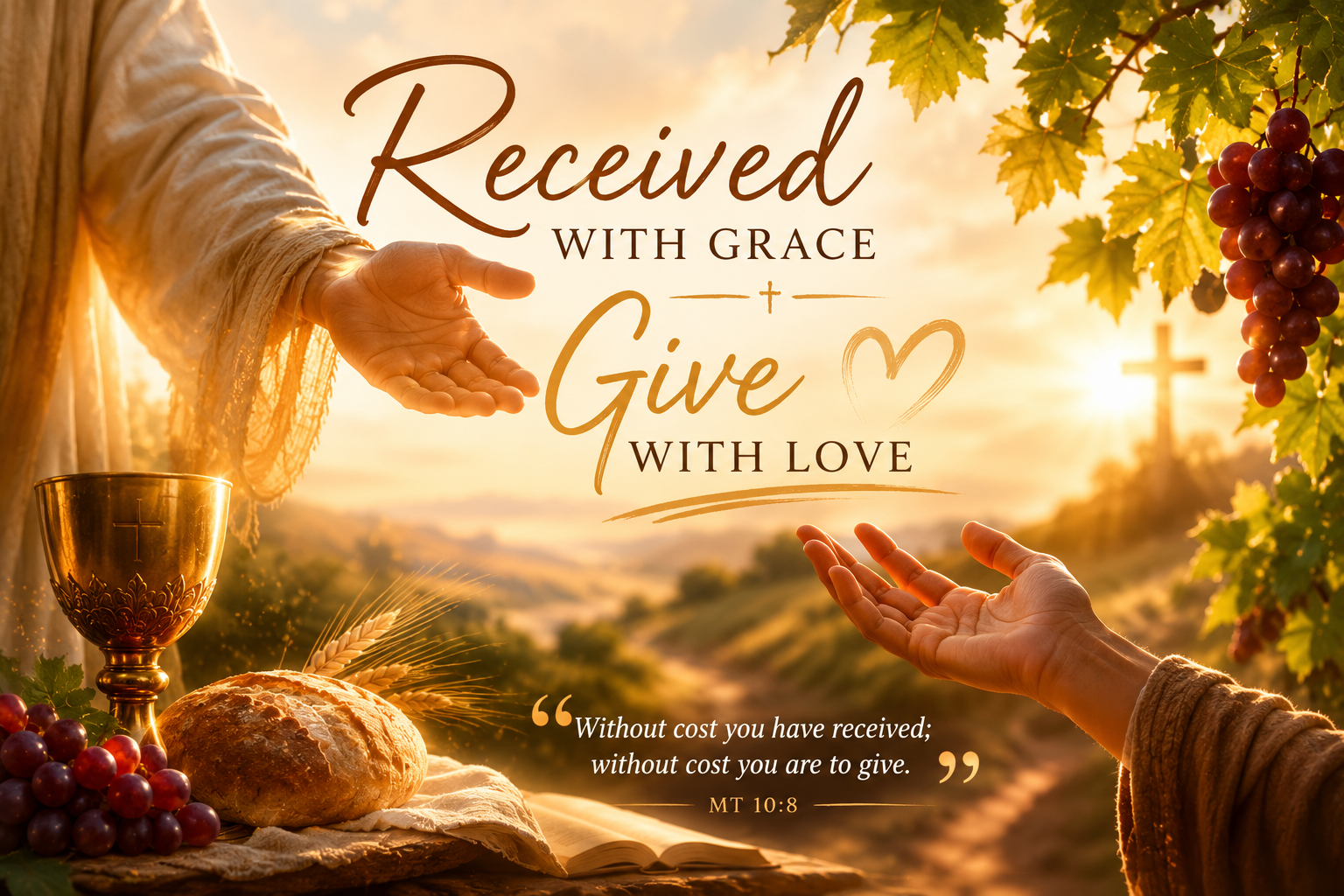
Received Without Cost
Matthew 9:36-10:8 | 11th Ordinary Sunday | Year A
“Without cost you have received; without cost you are to give.” (Mt 10:8)
At first glance, these words of Jesus seem to speak about generosity. Yet before speaking about giving, Jesus reminds the disciples of something more fundamental: they have first received. Their vocation, their mission, their friendship with him, and even the authority they now carry did not begin as achievements. They were gifts.
Perhaps this is one of the most difficult truths to accept. Human beings are often more comfortable earning than receiving. We understand effort, achievement, and reward. We are less comfortable with dependence. Receiving reminds us that not everything begins with us and not everything is under our control.
Deep within every person there seems to be a quiet tension. One part of us recognizes that life itself is a gift. We know that our existence, faith, vocation, relationships, and opportunities have been received rather than earned. Yet another part of us struggles to let go. It wants to secure itself, protect itself, and remain in control. It prefers achievement to gratitude and self-sufficiency to dependence.
Perhaps this is why asking for help can be so difficult. Admitting weakness can feel uncomfortable. Receiving forgiveness is often harder than offering it. Allowing oneself to be loved can be more challenging than loving others. The ego seeks control, while the heart slowly discovers that life can only be received.
St. Paul asks a simple question: “What do you possess that you have not received?” (1 Cor 4:7). The longer one remains with that question, the more unsettling it becomes. Everything that truly matters seems to have begun as a gift.
Perhaps the deepest poverty is not having nothing to give. Perhaps the deepest poverty is forgetting that everything began as a gift.
When this awareness fades, life easily becomes centred on achievement, success, recognition, and self-preservation. We begin to measure ourselves by what we accomplish rather than by what we have received. Gratitude slowly gives way to entitlement, and the heart becomes restless because it carries a burden it was never meant to carry alone.
The Gospel points toward a different way of living. Not a life without effort or responsibility, but a life rooted in the awareness that everything begins with grace. Giving freely becomes possible only when one has first learned to receive freely.
Perhaps this is the deeper meaning of the Christian journey. It is not primarily a process of becoming stronger, more capable, or more successful. It is a gradual movement from self-reliance toward trust, from possession toward gratitude, and from control toward surrender. The words of Jesus, “I in them and you in me” (Jn 17:23), “I am the vine, you are the branches” (Jn 15:5), and “Whoever eats this bread will live forever” (Jn 6:58), all point toward a communion in which life is no longer centred entirely on oneself but received continuously from God.
This movement is rarely sudden. It unfolds slowly through successes and failures, through moments of faith and moments of resistance. Perhaps all disciples live within this tension. One part of the heart knows that everything is gift. Another part still struggles to let go.
And yet we do not walk this path alone. Mary herself received before she gave. She entrusted herself to God and allowed his Word to take flesh within her. Her life reminds us that surrender is not the loss of oneself, but the discovery that everything has always been gift.