

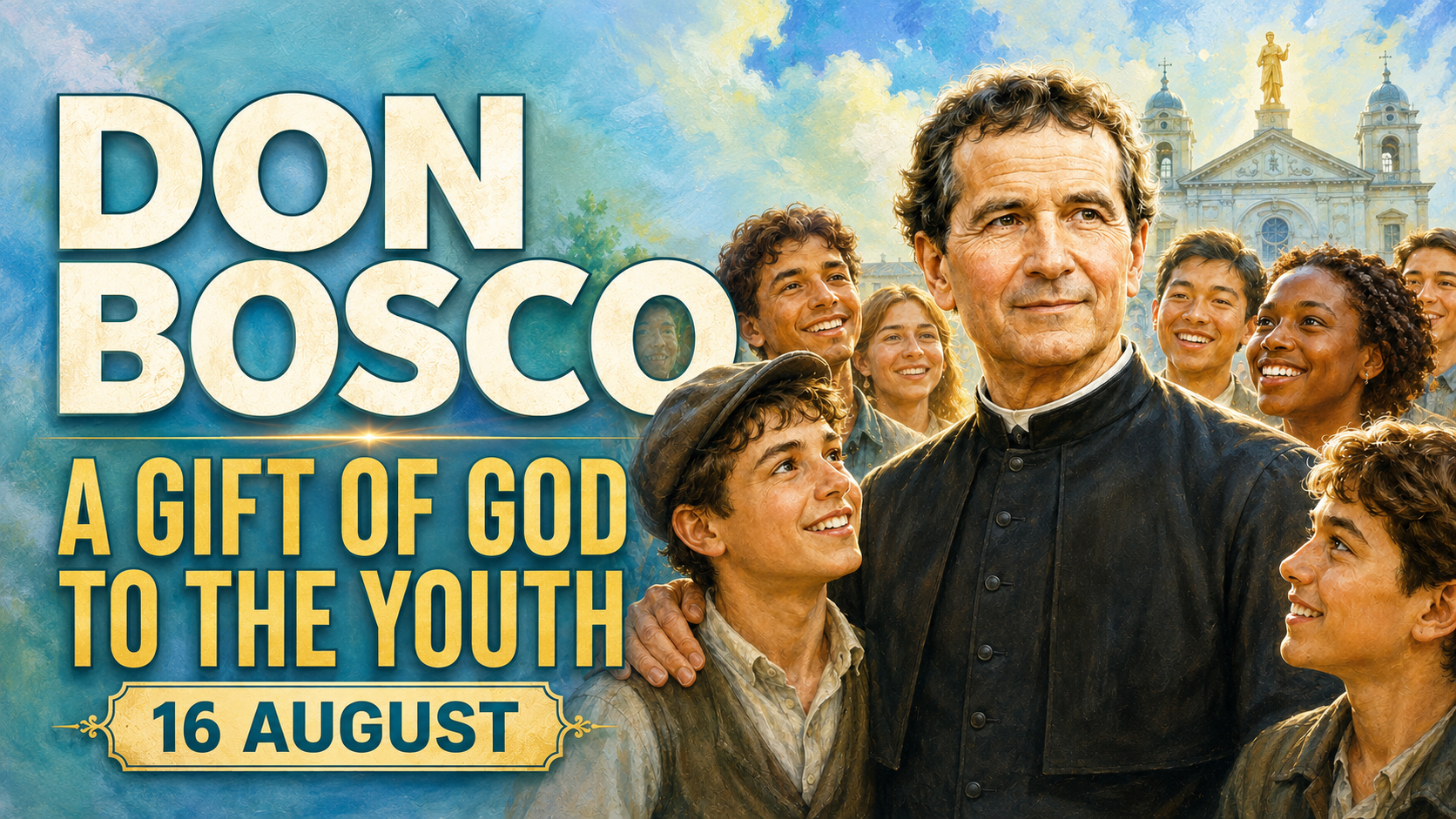
Don Bosco: A Gift of God to the Youth
A reflection for 16 August, the birthday of St John Bosco
Every year on 16 August, the Salesian Family and all those connected in one way or another to Salesian institutions remember with gratitude the birth of St John Bosco, born in 1815 in Becchi, near Turin. More than two centuries later, his name continues to awaken affection wherever young people are welcomed, educated and accompanied. Don Bosco belongs to the whole Church, but especially he belongs to the young. His life was a gift of God placed at their service.
To speak of Don Bosco as “a gift of God to the youth” is more than an expression of admiration. It points to the deepest meaning of his vocation. God called a poor boy from the countryside, formed him through hardship and faith, and sent him to become a father, teacher and friend of young people, especially those who were poor, abandoned and at risk.
A gift prepared from childhood
John Bosco’s childhood was marked by poverty, sacrifice and strong family faith. He lost his father when he was still very young and was raised by his mother, Mamma Margaret, whose simple and profound faith left an enduring mark on him.
At the age of nine, John had the famous dream that would illuminate the direction of his life. He saw a crowd of boys, some laughing, fighting and using bad language. When he tried to correct them by force, a mysterious Person told him:
“Not with blows, but with gentleness and charity you will have to win these your friends.”
This became, in a sense, the programme of his whole life.
Don Bosco gradually understood that young people are not transformed primarily by fear or punishment. They are won through love, trust, patience and the experience of being genuinely cared for. Young people need educators who believe in them and help them discover the goodness God has planted in their hearts.
A heart that saw what others did not see
When Don Bosco arrived in Turin as a young priest, the city was undergoing enormous social change. Industrialisation drew many young people from rural areas into the city. Some found work, but many faced exploitation, loneliness and poverty. Boys wandered through the streets, worked in dangerous conditions, or ended up in prison.
Where society often saw the young as a problem, Don Bosco saw a person.
Where others saw delinquency, he saw a young heart waiting for an opportunity.
Where others saw ignorance, he saw intelligence that needed education.
Where others saw hopelessness, he saw the possibility of holiness.
This was one of the great gifts God gave Don Bosco: the ability to see young people through the eyes of Providence.
He did not merely feel sorry for them. He entered their world. He visited prisons, searched for employment for apprentices, negotiated with employers, organised schools and workshops, found food and shelter, taught catechism, played with the boys and celebrated the sacraments with them.
For Don Bosco, evangelisation and education could never be separated from the concrete realities of a young person’s life.
“It is enough that you are young for me to love you”
One of the best-known expressions associated with Don Bosco captures the secret of his relationship with the young:
“It is enough that you are young for me to love you very much.”
His love was not sentimental. It was an educational love that demanded presence, sacrifice and responsibility.
Don Bosco wanted young people not only to be loved but to know that they were loved. This insight remains one of the most important principles of Salesian pedagogy.
An educator may provide excellent instruction, discipline and organisation; but if a young person never experiences personal concern, something essential is missing. Don Bosco therefore insisted on what the Salesian tradition calls “assistance”: the friendly, active and loving presence of educators among the young.
The playground, the classroom, the workshop, the chapel and the ordinary moments of daily life all became places of education.
This is why the Salesian educator is not simply someone who teaches from a distance. He or she walks with the young, shares their joys, listens to their struggles and becomes a credible witness through presence.
The Preventive Method: reason, religion and loving-kindness
Don Bosco’s educational vision is known as the Preventive Method. Its three great pillars are reason, religion and loving-kindness.
Reason means treating the young person with respect and helping him or her understand what is good. Education should not be arbitrary or oppressive. Young people must be guided toward responsible freedom.
Religion places God at the centre of education. Don Bosco wanted young people to discover that God loves them and has called them to holiness. Prayer, the Eucharist, Reconciliation and devotion to Mary were not additions to his educational programme; they were at its heart.
Loving-kindness, or amorevolezza, means the warm and visible expression of an educator’s love. Young people grow when they encounter adults who are patient, approachable, compassionate and genuinely interested in their lives.
These three dimensions go hand in hand. Reason without love can become cold. Love without reason can become permissiveness. Religion without a human and welcoming environment can appear distant from life. Don Bosco brought all three together in an educational spirituality capable of forming the whole person.
Don Bosco believed that holiness was possible for the young
Perhaps one of Don Bosco’s greatest gifts to young people was his conviction that holiness is not reserved for adults, priests or religious. Young people too are called to become saints.
His guidance of St Dominic Savio remains the clearest example. Don Bosco did not teach Dominic to escape ordinary youthful life. He taught him to find God within it, in study, friendship, recreation, service, prayer and fidelity to daily duties.
Salesian holiness is therefore joyful and practical. It grows through friendship with Jesus, devotion to Mary, cheerful service of others and the faithful fulfilment of everyday responsibilities.
For Don Bosco, sadness and holiness did not belong naturally together. His houses were filled with music, games, theatre, celebrations and friendship. He understood something deeply Christian: joy can become a road to God.
“Give me souls; take away the rest”
The deepest motive of Don Bosco’s life is expressed in the biblical phrase he adopted as his motto:
“Da mihi animas, cetera tolle” (“Give me souls; take away the rest”).
These words reveal the pastoral fire within him. His schools, workshops, playgrounds and institutions were never ends in themselves. Everything was directed toward the good and salvation of the young.
He wanted them to become what he famously described as “good Christians and honest citizens.”
For Don Bosco, the young person was never merely a student to be instructed or a beneficiary to be assisted. Each young person was a child of God, worthy of dignity, capable of goodness and called to eternal life.
Don Bosco’s gift continues today
On his birthday, we do not simply remember a great educator who lived in nineteenth-century Italy. We celebrate a charism that remains alive.
The world of young people has changed dramatically since Don Bosco walked through the streets of Turin. Today’s young people inhabit a digital world. They face new forms of isolation, anxiety, violence, migration, family fragility, unemployment and uncertainty about the future. Many are surrounded by constant communication yet experience profound loneliness. Others hunger for meaning but do not know where to search for it.
In this changing world, Don Bosco’s question remains urgent:
Who will be present among the young?
Who will listen before judging?
Who will believe in them when they have stopped believing in themselves?
Who will create homes where they feel welcome, schools where they learn for life, parishes where they encounter Christ and playgrounds where friendship and joy can flourish?
This is the continuing mission of every educator and especially of the Salesian Family.
A birthday that becomes a call
The best way to celebrate Don Bosco’s birthday is not merely to speak about him but to continue what God began through him.
Every parent who patiently listens to a young person, every teacher who gives a struggling student another opportunity, every Salesian who remains joyfully present among the young, every animator who welcomes a lonely child, and every member of the Salesian Family who chooses to hope over discouragement continues something of Don Bosco’s mission.
Don Bosco was God’s gift to the youth because he made his whole life available to them.
On this 16 August, we thank God for the boy born at Becchi who became Father and Teacher of Youth. We thank God for his joyful holiness, his educational wisdom and his passionate love for young people.
And perhaps the most fitting prayer on his birthday is this:
St John Bosco, Father and Teacher of Youth, help us to see the young as you saw them, to love them as you loved them, and to lead them with gentleness, joy and hope toward Jesus Christ. Teach us to make our homes, schools, parishes and communities places where every young person can experience that they are welcomed, valued and loved by God.
Happy Birthday, Don Bosco!
Continue to walk with the young, and teach us to walk with them too.