

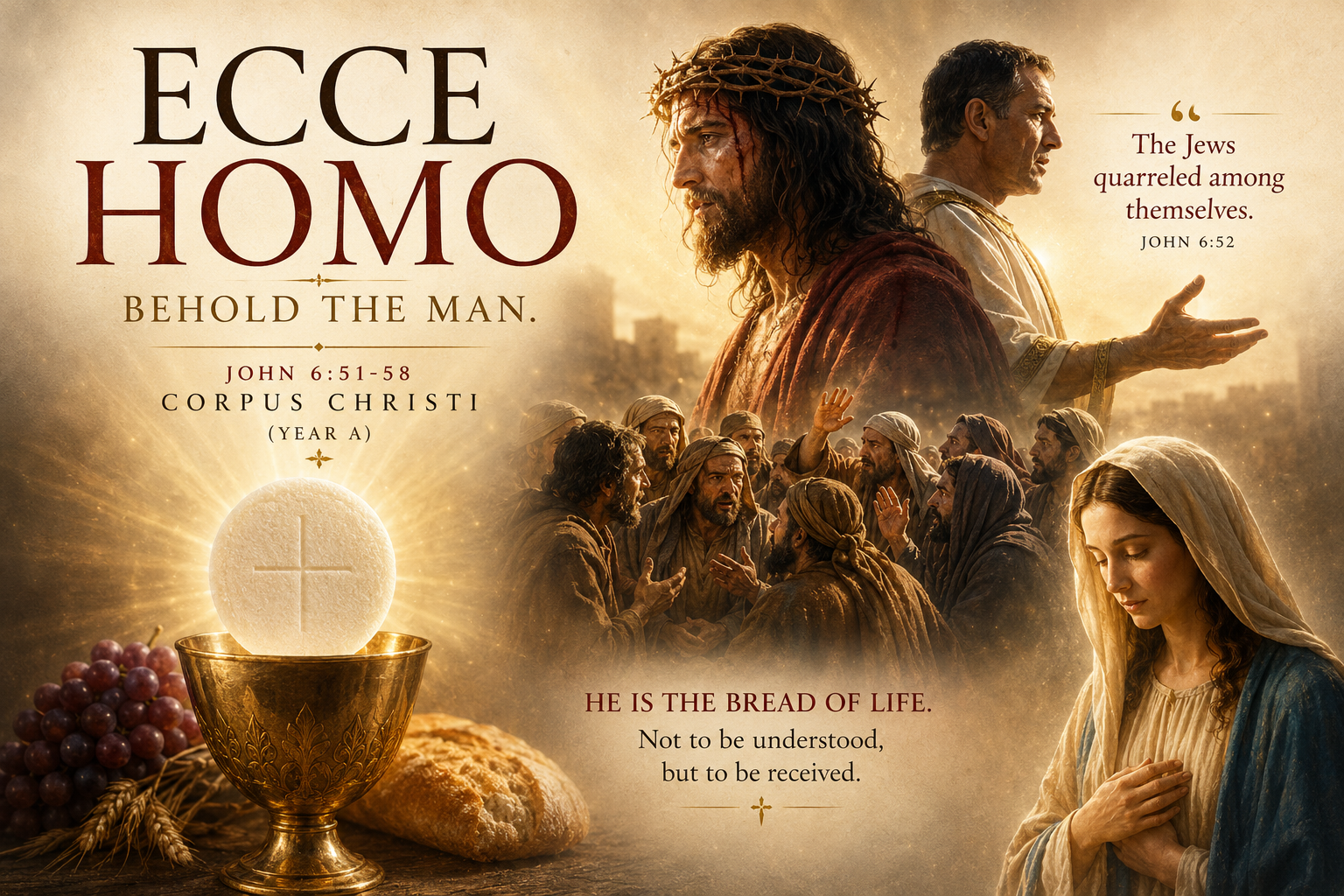
Ecce Homo
John 6: 51-58 | Corpus Christi | (Yea A)
Ecce Homo - Behold the man.
These words were spoken by Pilate while standing before Jesus. He was neither a disciple nor a believer. He did not understand Jesus, nor did he possess the faith of those who followed him. Yet there is something striking about Pilate. He engaged Jesus in conversation. He listened. He questioned. He hesitated. He even tried to set him free. In the end he chose what was safe and familiar, securing his position rather than entrusting himself to the truth that stood before him.
The Gospel of Corpus Christi presents another scene. Jesus reveals himself as the Bread of Life and speaks of giving his flesh for the life of the world. The response is immediate:
“The Jews quarreled among themselves.” (John 6:52)
Their reaction is deeply human. Faced with a mystery that exceeds understanding, they begin to argue. They search for explanations. They struggle with what Jesus has said. Yet the Gospel quietly notes something important. Their attention turns toward one another. The One who is speaking remains before them, but they become absorbed in the argument surrounding his words.
Perhaps this is why the passage feels so close to ordinary life.
Many Catholics, priests, and religious sincerely profess faith in the Eucharist and yet, at times, find it difficult to believe. We look for certainty. We look for evidence. We seek explanations that can make the mystery manageable. There is nothing surprising or shameful about this. It is part of being human.
The tragedy is not that we struggle to believe; the tragedy is that, in the struggle, we can lose sight of the One who stands before us.
The crowd did not lose an argument. They lost their attention to Jesus.
Pilate did not lose a debate. He lost himself in the need to protect his own position.
In both cases the mystery remained present, yet something else occupied the centre of their hearts.
Perhaps this is why the Eucharist remains such a profound mystery. It refuses to become an object that can be fully grasped, explained, or controlled. The Eucharist was never given primarily to be solved. It was given to be received.
And genuine reception often begins in a place of humility. Not with complete understanding, but with the honest recognition of one’s own limitations. Not with certainty, but with the courage to remain before a mystery that exceeds us.
Perhaps the most truthful prayer before the Eucharist is not, “Now I understand,” but: “Lord, I believe; help my unbelief.”
And quietly, the Gospel becomes a question for the heart.
When faced with what I cannot fully understand, what occupies the centre of my attention? The mystery itself, my own arguments, or the One who stands before me?
Mary appears only briefly, yet she offers a different response. She did not understand everything that God was doing in her life. Yet she received the Word and allowed herself to be led by a reality greater than her understanding.
Perhaps the distance between Pilate, the crowd, and Mary is not measured by how much they understood, but by what they did with the mystery standing before them.
Pilate secured himself.
The crowd argued.
Mary received.