

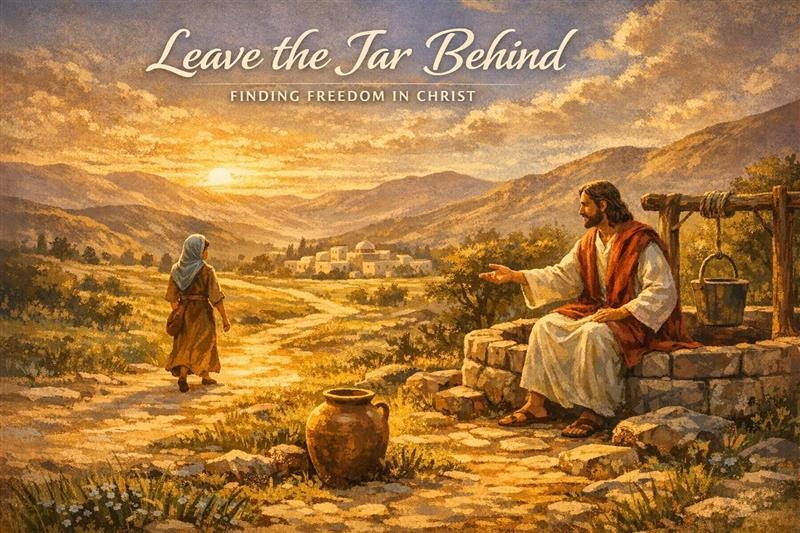
Leaving the Jar
In the encounter at the well, Jesus tells the Samaritan woman, “I am he, the one who is speaking to you.” It is a simple sentence, yet everything changes in that moment. Recognition happens. What was unclear becomes personal. What was distant becomes present.
The conversation between Jesus and the Samaritan woman slowly unfolds layers of thirst, misunderstanding, history, and hidden wounds. She comes to draw water, but she carries more than a jar. She carries the weight of divisions between Jews and Samaritans. She carries the complexity of her own story. She carries memories.
At the end of the dialogue, something quiet, but profound takes place. The woman leaves her jar behind. The jar that brought her to the well is no longer what she needs to carry back. She returns to her village lighter than she came.
Perhaps each of us also walks with a jar.
Not always a visible one, but one filled with memories that have not healed. Unforgiven moments. Words that wounded. Situations that continue to echo within us. Anger carefully preserved. Pain that we revisit again and again. Sometimes we carry these without even knowing how heavy they have become.
We move through life holding them, searching for somewhere to place them. At times, we hold them so tightly that they begin to define us.
In the Gospel, the turning point is not when Jesus explains everything. It is when she recognises him. “I am he.” Recognition changes everything. When she sees who is before her, the jar loses its necessity.
Jesus is not only present at ancient wells. He waits within the ordinary spaces of our own lives. In conversations. In disappointments. In unexpected encounters. Often, we fail to recognise him. Perhaps because we are still holding our jars too tightly.
Recognition does not erase the past, but it loosens its hold. When Christ is recognised in our own story, when we allow his presence into the places we keep guarded, something begins to shift. The jar can be set down.
The woman runs back to her village, not with arguments, but with experience. “Come and see.” She speaks from encounter, not from theory.
There may be moments in our own prayer when we gently ask ourselves: What am I still carrying? What jar have I grown accustomed to holding? And have I truly allowed myself to recognise the One who is already speaking to me?
Perhaps happiness is not found in controlling our past, but in recognising Christ within it. And maybe freedom begins not with solving everything, but with leaving the jar at his feet.