

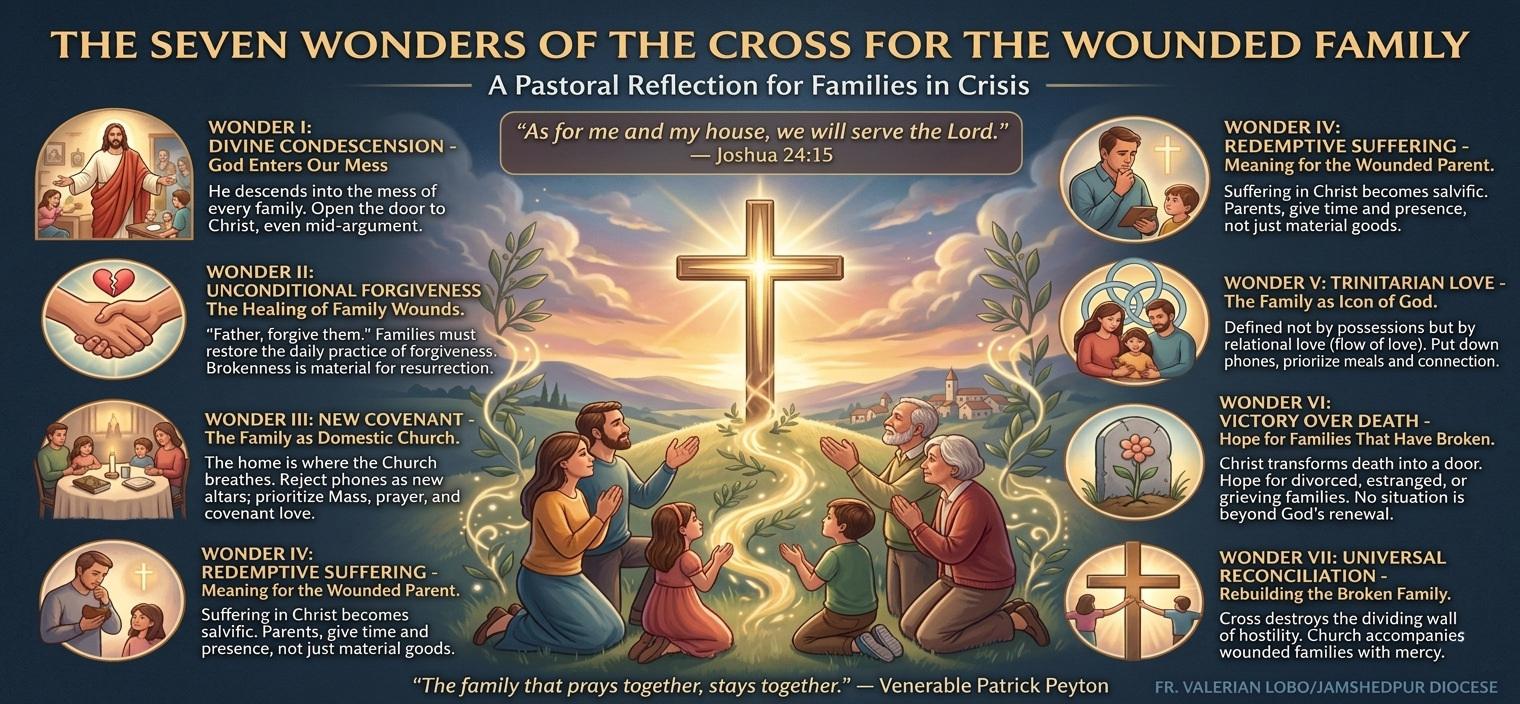
The Seven Wonders of the Cross for the Wounded Family – English
The Seven Wonders of the Cross for the Wounded Family: A Pastoral Reflection for Families in Crisis
"As for me and my house, we will serve the Lord." — Joshua 24:15
"As for me and my house, we will serve the Lord." — Joshua 24:15
Introduction: The Family at the Foot of the Cross: The modern family is bleeding quietly. Not from dramatic catastrophe, but from a slow haemorrhaging — screens replacing conversation, ambition displacing tenderness, busyness crowding out belonging. Families fracture not always with a bang, but with the gradual silence of people living under the same roof yet worlds apart. The single parent carries invisible exhaustion; the only child grows up in a house full of things but starved of siblings and shared laughter; spouses become strangers bonded by a mortgage and a schedule. Most dangerously, many families today have lost the sense of sin — not because they are virtuous, but because they have lost the sense of God. When God departs from the hearth, so does the moral compass, the sacrificial love, and the covenantal commitment that hold families together. Into this silent crisis, the Cross of Jesus Christ speaks with shattering tenderness. Its seven wonders are not abstract theology — they are a precise diagnosis and a radical healing for the wounded family of our age.
1. Wonder I: Divine Condescension — God Enters Our Mess: The first wonder is that God did not wait for the family to become perfect before entering it. The kenosis of Christ — His self-emptying (Phil 2:6–8) — means He descended into a human family: impoverished, displaced, under political threat, misunderstood. The Holy Family was not a postcard of domestic perfection; it was a refugee family, a working-class family, a family that lost their twelve-year-old son in Jerusalem. St. Augustine wrote: "God did not love us because we were loveable; He made us loveable by loving us." This is the word every struggling family needs to hear. God does not ask your family to be functional before He enters it. He enters precisely the dysfunction. Families who feel too broken, too distracted, too secular for God are precisely those He seeks. The pastoral invitation is clear: open the door of your home to Christ (Rev 3:20), not after the arguments stop, but in the middle of them.
2. Wonder II: Unconditional Forgiveness — The Healing of Family Wounds
"Father, forgive them; for they know not what they do" (Lk 23:34). These words, spoken over those who betrayed and abandoned Him, are spoken equally over every family gathered around its particular wounds — the father who was absent, the mother who was harsh, the child who wandered, the spouse who betrayed trust. The crisis of the contemporary family is in large part a crisis of unforgiveness. Pope St. John Paul II, in Familiaris Consortio (§21), identified forgiveness as the heartbeat of family life: "The family is the first school of forgiveness." Yet today, with the sense of sin eroded — replaced by therapeutic self-justification and social media's culture of blame — families no longer confess, no longer reconcile, no longer kneel together at the foot of the Cross. Viktor Frankl observed that the human person can endure almost any wound if they find meaning in it. The Cross gives every family wound a redemptive address: it is not wasted pain, it is material for resurrection. The pastoral call is to restore the domestic sacrament of reconciliation — the daily, unglamorous practice of saying "I was wrong. Forgive me."
3. Wonder III: New Covenant — The Family as Domestic Church
The Cross inaugurates a New Covenant (1 Cor 11:25) — and the family is the privileged space where this covenant is lived daily. Vatican II's Lumen Gentium (§11) gave the Church one of its most beautiful phrases: the family as ecclesia domestica — the domestic Church. The home is not merely where Christians live; it is where the Church breathes. Yet the domestic church is under siege. Mobile phones have become the new altars — worshipped at breakfast, at dinner, in bed. Excellence, money, and academic performance have become the new trinity, replacing Father, Son, and Holy Spirit. Pope Francis warns in Amoris Laetitia (§276): "We cannot encourage a path of holiness that does not fill one's whole life." When family prayer disappears, when Sunday Mass yields to Sunday sport or academic tuition or dance class, the covenantal structure of family life quietly collapses. The Cross calls families back to covenant consciousness — the radical countercultural conviction that this family, this marriage, this parent-child bond is a sacred and inviolable gift from God.
4. Wonder IV: Redemptive Suffering — Meaning for the Wounded Parent
"I complete what is lacking in Christ's afflictions for the sake of his body" (Col 1:24). The single mother working double shifts, the father estranged from his children, the mother or father leaving behind his/her children for work at a distant place, the couple carrying the silent grief of infertility or addiction in their home — these are not outside the Cross; they are within it. Yet there is a particular wound that cuts even deeper and is rarely named from the pulpit: today, in far too many homes, parents have been reduced — or have allowed themselves to be reduced — to little more than ATM machines and credit cards for their children. They provide every material comfort, every gadget, every fee, yet remain emotionally absent, spiritually invisible, and relationally unknown to the very children they sacrifice so much to fund. The child receives the parent's money but is starved of the parent's presence, prayer, and love. This is not generosity — it is a sophisticated form of abandonment dressed in the language of provision. John Paul II's Salvifici Doloris teaches that suffering united to Christ becomes salvific — not merely endured, but transformed. The psycho-spiritual insight here is profound: meaningless suffering destroys; meaningful suffering forges. Families in difficulty do not need their suffering removed as much as they need it redeemed. The pastoral task is to help suffering families name their cross, carry it consciously, and trust that the Easter morning on the other side is real. For the parent who has sacrificed time, presence, and relationship at the altar of financial provision — the Cross offers not condemnation but a new calling: to give not only what is in the wallet, but what is in the heart.
5. Wonder V: Trinitarian Love — The Family as Icon of God
The Trinity is the original family — three Persons in one communion of self-giving love. The Cross reveals the very interior life of God: the Father's sending love, the Son's surrendered love, the Spirit as the Love between them. Pope John Paul II, in Letter to Families (§6), declares: "God in his deepest mystery is not solitude, but a family." This means that every family — however broken — carries within its very structure an icon of the divine. But the family ravaged by individualism, by the isolation of single-child households, by parents absorbed in screens and careers, has suppressed this icon. Crucially, the Trinitarian mystery reveals that what defines the Persons of God is not what they possess but how they relate. The Father is not defined by authority alone, nor the Son by obedience alone — they are defined by the love that flows ceaselessly between them. So too, a parent is not defined by what they provide financially, but by the love they pour out in time, attention, and presence. When the parent becomes merely a provider and the child merely a beneficiary, the family has ceased to image the Trinity and begun to image a transaction. The Cross calls families to relational conversion: to put down the phone and look into the eyes of the child; to choose shared meals over efficient eating; to rediscover that the family table is a eucharistic space.
6. Wonder VI: Victory over Death — Hope for Families That Have Broken
"O death, where is your sting?" (1 Cor 15:55). Many families feel they have already died — through divorce, estrangement, addiction, or grief. The Cross without the Resurrection is tragedy; but the Cross as gateway to Resurrection is the Church's most urgent pastoral proclamation. Pope Benedict XVI wrote: "Christ transforms death from a wall into a door." This is the word for the divorced parent who believes the family dream is permanently dead; for the prodigal child who believes reconciliation is impossible; for the couple on the edge of separation who cannot imagine a future together. The Resurrection does not undo the Cross — it passes through it. No family situation is beyond God's capacity to renew, provided there is a willingness to die to the self-protective walls we have built. Hope is not optimism; it is the theological virtue that plants seeds in frozen ground.
7. Wonder VII: Universal Reconciliation — Rebuilding the Broken Family
The outstretched arms of the crucified Christ are the geometry of reconciliation — vertical (God and the family) and horizontal (parents and children, spouses with each other, siblings across wounds). "God was in Christ reconciling the world to himself" (2 Cor 5:19). The Cross destroys "the dividing wall of hostility" (Eph 2:14) — the wall between the workaholic father and the lonely child; between the exhausted mother and the resentful teenager; between spouses who have become co-managers rather than lovers. Desmond Tutu, reflecting on reconciliation, observed that it requires a third party willing to absorb the brokenness of both sides. Christ is precisely this third party in every fractured family. Amoris Laetitia (§312) tenderly affirms that the Church accompanies wounded families not with condemnation but with the mercy of the Cross.
Final Task: Bring Your Family to the Foot of the Cross
The seven wonders of the Cross are seven medicines for the seven wounds of today's family. Against the numbing sense of sinlessness — the wonder of forgiveness. Against isolation — the wonder of Trinitarian communion. Against meaningless suffering — the wonder of redemptive love. Against the fear that it is too late — the wonder of resurrection. Against the idol of money and achievement — the wonder of kenotic self-giving. Against the breaking of bonds — the wonder of covenant. Against despair — the wonder of universal reconciliation. The family is not a sociological unit. It is, as the Church has always taught, the way of the Church — the irreplaceable school of love where every generation either learns or forgets how to be human. Let families bring their wounds, their silences, their screens, and their exhaustion to the foot of the Cross. For there, as Mary stood and did not run (Jn 19:25), we too are invited to stand — and to discover that the Cross is not the end of the family's story, but its most glorious beginning. "The family that prays together, stays together." — Venerable Patrick Peyton
FR. VALERIAN LOBO/JAMSHEDPUR DIOCESE/9113782481