

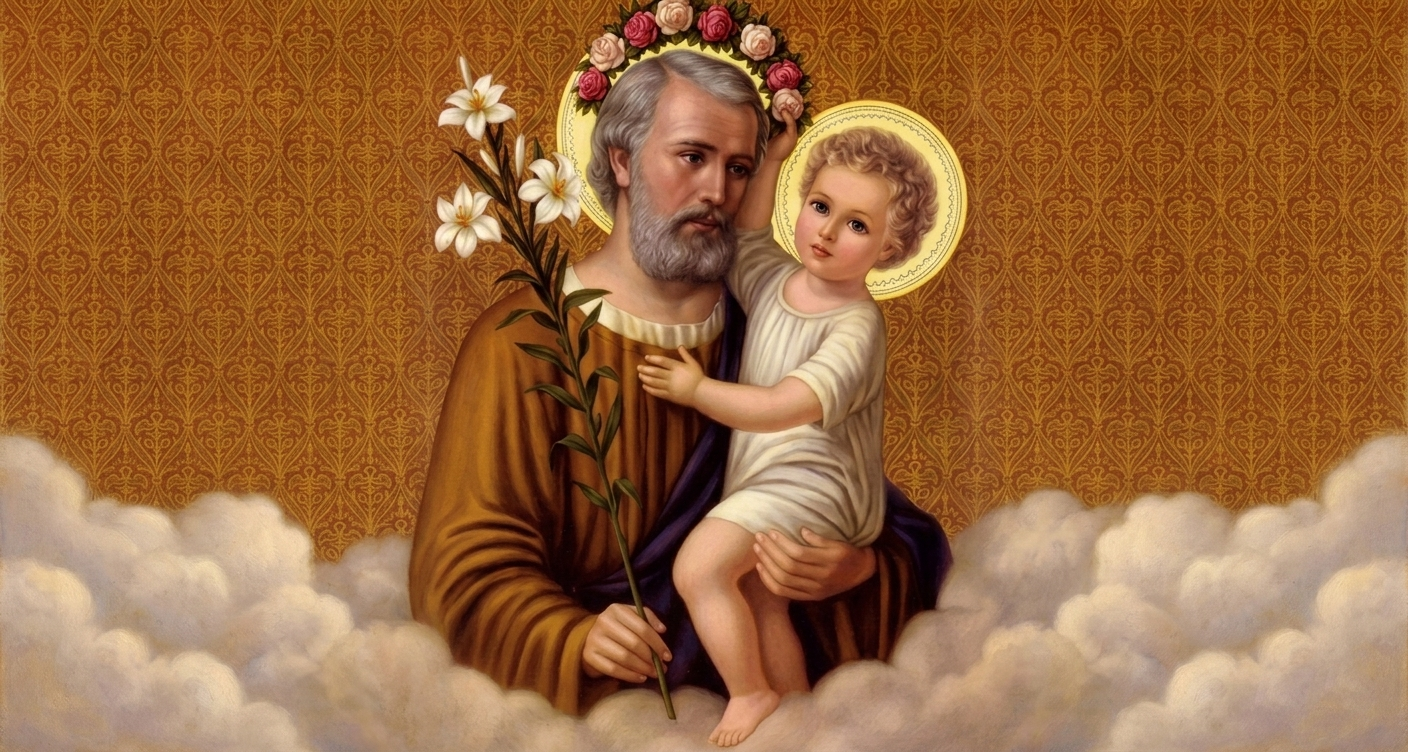
St Joseph, the Custodian of Jesus and a Model Father for Families
Introduction
During a famine in Egypt, the people crowded around Pharaoh, crying for bread. The Pharaoh said, “Go to Joseph, what he says to you, do” (Gen 41:55). Well! We have a Joseph in the New Testament, too, to whom we can go with confidence. He, too, is a wise and prudent administrator. We go to him not only to do what he says, but also to imitate what he has done! Here is a man who appreciated the things of this passing world, but clung to what lasts forever! Let me mention a few things that Joseph did and taught through his silent life – but a dynamic silence at that.
-
Joseph was a man of God to whom the Lord spoke in dreams
The author of the Letter to Hebrews writes about a God who speaks in many and various ways to his chosen ones (Heb 1:1). This communication certainly includes visions and dreams. God also spoke to Joseph, the spouse of the Blessed Virgin Mary, through dreams and visions (see Mt 1-2). Dreams and visions, among other things, show that a man or woman is in touch with God, or rather, they are men and women of God. They are intimate with God. Like Enoch of old, who walked with God (see Gen 5:22-24), Joseph too walked with God. He lived in the company of God. He led a life pleasing to God! Joseph comes across to the perceptive readers of the NT as a spiritual person who had discovered the importance of being a man of God.
-
Joseph was accommodating and in tune with God’s WordJoseph accepted God’s plans for him! He had the responsibilities of a father without being a father [of Jesus] in the biological sense. He lived happily and joyfully through the inevitable vicissitudes of life. He knew how to accept the inscrutable and enigmatic ways of God. He did not lament over the harsh circumstances of life. He did not protest when he had to go all the way to Bethlehem with Mary, who was expecting her baby to be born shortly. As a law-abiding Jew, he was troubled but patient when he realised that Mary was with child. He waited patiently for God to intervene. His plans and God’s ways merged. In other words, he was able to resonate with God’s ways. Thus, he demonstrated an enviable capacity to accommodate God’s mysterious guiding. Joseph’s life is an invitation to be attuned to God’s word.
-
Joseph is an icon of resilienceJoseph was consistent in doing God’s will. In fact, he displays prompt obedience to God’s will (see Mt 1-2). He aligned his life with God’s will. In imitation of Jesus, who said, “My food is to do the will of him who sent me and to complete his work” (see Jn 4:34), Joseph showed his mettle through his resilience. He followed without dillydallying the directive of the sacred author, “You need endurance if you are to do God’s will and win what he has promised” (Heb 10:36).
-
Joseph accompanied the child Jesus, who was growing in wisdom and statureAs a loyal and devout Jew, Joseph celebrated the Jewish festivals. He went regularly to Jerusalem to listen to God’s word. The obligation to appear before God for the festivals was meant for adult men only (Exod 23:17)! However, he did not go by the minimum requirements. He did not limit himself to his personal obligations. As a true and wise father, he took along little Jesus and his mother year after year to the distant Jerusalem. He was aware that the little Jesus would grow to maturity when the spiritual and religious dimensions were taken care of. He made the tedious journey to ensure that baby Jesus would grow in wisdom and stature and find favour with God and man. Here was a father who paid attention to the overall formation of Jesus. He teaches parents the need to accompany children and teenagers, in particular, in their journey of faith.
-
The just Joseph did not follow the letter of the law but the spirit of the lawMathew says that Joseph was a just man (Mt 1:19). This is a heavily loaded word in the Matthean Gospel. Mathew speaks of Joseph as a just man when he was confused since Mary was with a child. This is a compliment since it is also a quality of Jesus. The centurion, who saw the way in which Jesus died, said, “Certainly this man was just” (Lk 23:47). All what Jesus is can be condensed into that statement of the centurion – Jesus was a just man! Jesus had not condemned the sinful woman caught in adultery (see Jn 8:10-11). That was the attitude of Joseph as well. He wanted to send Mary away quietly instead of stoning her as the law demanded! The righteous man is sympathetic towards those who have failings. Mary was guilty. There are stringent laws about infidelity in marriage. Death is the punishment for those who are unfaithful in matters related to marriage (see Deut 22:22-27). Joseph, however, did not go by the letter of the law. Somehow or other, he lived by the advice of the Apostle Paul, which would be given years later: “the written code kills, but the Spirit gives life” (2 Cor 3:6). Joseph displayed a benign and merciful attitude toward his spouse. Indeed, he manifested a magnanimous and merciful disposition towards Mary, although he had not yet been told that Mary had conceived by the power of the Holy Spirit!
-
Joseph seemed to have only obligations and not rightsDuring his life, Joseph walked the ‘narrow way’. Every step was riddled with problems. He certainly did not have a life of comfort. He knew that those who come to serve the Lord should be prepared for testing (see Sir 2:1-2). From the very start, his life was riddled with problems. A long journey to Bethlehem was bad enough. Then, to make matters worse, there was no place in the inn for his spouse, who was about to have a child. It was further complicated when King Herod sought to kill the child. Therefore, they had to undertake a long and perilous journey all the way to Egypt to save the child from an ambitious king. The three had to adjust to life as migrants in a foreign land. [Tradition has it that they spent about seven years or more in Egypt. Jesus had his schooling there, learning, among other things, also Greek.]
-
Joseph earned a reputation as a competent carpenter“Is not this the carpenter’s son?” (Mt 13:55). When Jesus taught and worked miracles, this is what his contemporaries commented. They all knew Joseph, the renowned carpenter in the town of Nazareth. Joseph was like Bezalel and Oholiab – skilled workmen of old whom Moses recruited for the construction of the tabernacle (see Exod 36:2-7). Joseph was truly the wiseman that the book of Proverbs speaks of, skilled in God’s ways and capable of accomplishing the Lord’s designs. His reputation had spread as a competent and skilled worker. He knew the value of work, and as such, was capable of providing for the needs of the family as the sage suggests (see Prov 6:6-11; see also Apostle Paul’s exhortations on work in 2 Thes 3:6-13). Here was a man who knew the precious dimension of work. Joseph had become a skilful and competent worker!
-
Joseph knew how to play the second fiddleThe angel told Joseph about the status of Mary. She was the fulfilment of Isaiah’s prophecy – “A virgin shall conceive and bear a son” (Mt 1:23 // Isa 7:14). He came to know that Mary is the mother of God, the mother of the Saviour, the mother of the ‘one who is coming’ into the world as the Messiah! This certainly filled him with veneration and admiration. As a true father, he cared for the family – for Mary and her divine son. He stood by in silence and humility when Jesus was lost in the temple. Contrary to customs of the day, it is Mary who is asking Jesus, “Son, why have you treated us so? Behold your father, and I have been looking for you anxiously” (Lk 2:48). Joseph gave Mary precedence and prominence. Differently put, he is ever ready to play the second fiddle. He lived a hidden life and did not seek to come into the limelight. He never sought a glamorous life but rather a humble life of service. Therein lies his greatness.
Conclusion
I have limited myself to eight lessons that we can learn from Joseph. The Gospels do not say much about Joseph. What we have is terse, yet it offers us much food for thought. He is indeed the prudent, wise, and God-fearing man that the Wisdom books in particular speak about. To imitate Joseph is to make our lives resemble his. We become useful and credible in the family and society when we make our own lives like that of Joseph!