

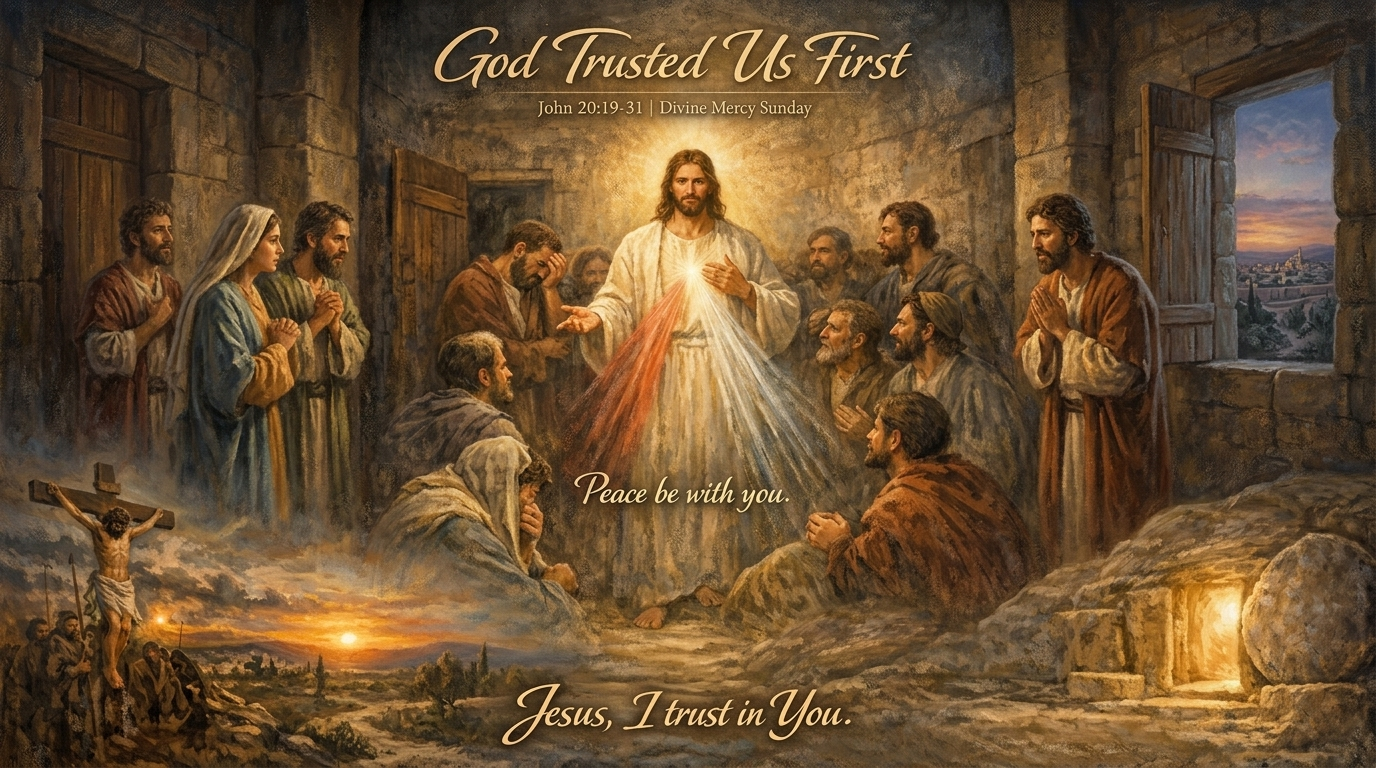
God Trusted Us First
John20: 19-31 | Divine Mercy Sunday
The disciples were gathered behind closed doors. The Gospel tells us they were afraid. The doors were locked. Fear, confusion, and perhaps even shame filled the room. They had followed Jesus, believed in him, hoped in him; and yet when the decisive moment came, many of them ran away. Peter had denied him. Others had abandoned him.
And into that room, into that exact moment of fear and failure, Jesus came and stood in their midst. He did not wait until they were ready. He did not wait until they had overcome their fear.
He did not wait until they had fully understood what had happened.
He simply came.
And the first words he spoke were not words of accusation, but words of peace: “Peace be with you.” Then something even more surprising happens. The risen Lord entrusts them with his mission. “As the Father has sent me, so I send you.” The very ones who had failed him are now entrusted with continuing his work.
Perhaps the real miracle in this Gospel is not only that Jesus rose from the dead. The deeper miracle is that he still trusts the very people who failed him. This is the quiet mystery at the heart of Divine Mercy.
God trusted humanity first. Even on the cross, Jesus entrusted his life and his love to people who would abandon him, doubt him, and deny him. Yet his love did not end there. It continued beyond the cross, beyond the tomb, into the resurrection.
And now the risen Lord stands again in the midst of his disciples; not to condemn them, but to trust them. This raises a quiet but profound question for each of us: Do we believe that God trusts us, even with our weaknesses and failures?
Often we find it difficult to trust God fully. We hesitate, we doubt, we hold back. And yet the paradox of the Gospel remains: God trusts us with his love, while we struggle to trust his mercy.
Divine Mercy Sunday gently invites us to look at our own hearts:
Are there doors in our lives that remain closed out of fear? Are there parts of our past that we hesitate to revisit? Are there failures or wounds that still keep us hiding behind locked doors? What would happen if we allowed Christ to stand in the midst of those places? Can we believe that he comes not to accuse us, but to bring peace?
And another question arises quietly: If God trusts us with his love, are we willing to trust his mercy?
The disciples believed because they saw the risen Lord standing before them. But Jesus also speaks to those who will come after them: “Blessed are those who have not seen and yet believe.”
Faith is not only about understanding everything that has happened in our lives. Sometimes it is simply about trusting that the risen Lord still comes into the closed rooms of our hearts. Not with judgment. But with peace.
And perhaps the prayer of Divine Mercy is nothing more than a simple response to this great paradox:
Jesus, I trust in You.